GEO Best Practices: How Brands Can Stay Visible in AI Search
AI summaries are taking clicks away from traditional search. Brands need to become part of the answer as well as compete for rankings. This article distills seven GEO practices from Orange 142's guide, including structured content, direct answers, entity relationships and credible sources.
Topics
4Summary
AI summaries are taking clicks away from traditional search. Brands need to become part of the answer as well as compete for rankings. This article distills seven GEO practices from Orange 142's guide, including structured content, direct answers, entity relationships and credible sources.
Digital marketing is undergoing a fundamental shift as generative AI becomes part of search-engine architecture. Traditional SEO competes for positions among blue links, while answer engines synthesize information and provide answers directly within the search interface, without users needing to click a website.
For brands, the risk is no longer just ranking lower: it is being absent altogether.
The shift to answer engines
Traditional search engine optimization (SEO) focuses on high positions in a list of links to drive traffic to external websites. Answer engines change this dynamic: instead of merely pointing to information, they synthesize it and answer complex questions directly within the search interface.
This shift has created the zero-click phenomenon: users can satisfy their information needs without leaving the search results. Forecasts suggested that around 60% of searches in the US and Europe could be zero-click experiences by 2025. Gartner projected that brands' organic search traffic could decline by 50% or more by 2028.
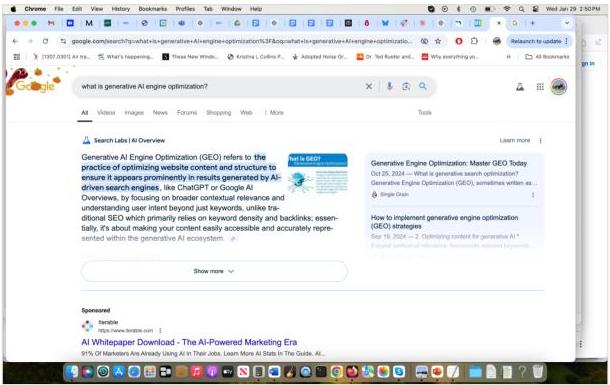
GEO—Generative Engine Optimization—is a strategic framework developed to address this challenge, ensuring that brand content is not only indexed but also accurately synthesized and cited by AI-powered search systems.
Four types of platforms in the information-retrieval landscape
The generative AI platforms shaping information retrieval can be grouped into four main categories:
- Generative AI-enhanced search —traditional search engines with a generative layer, such as Google SGE and SearchGPT. They retain conventional search infrastructure while adding conversational summaries above the results.
- Conversational generative search —platforms such as Perplexity are built around a conversational interface. Users hold a conversation rather than enter a list of keywords. These engines prioritize immediate synthesis and live source citations.
- Autonomous research agents —tools such as OpenAI's Deep Research perform multi-step tasks, browse multiple pages and compile comprehensive reports.
- Multimodal AI search —engines such as Claude and Gemini can process and generate information in multiple formats, responding more comprehensively to user intent.

These platforms follow a fundamentally different logic from traditional search. SEO is built on keywords and backlink authority; the generative era is defined by semantic understanding and algorithms' ability to interpret the intent behind a query.
GEO's three core objectives
The reasons for adopting GEO fall into three areas:
- Mitigate traffic loss —as organic traffic is expected to decline substantially, brands need to appear in AI-generated summaries. Brands that are not cited become invisible to users who never scroll beyond the initial answer.
- Preserve narrative integrity —when AI synthesizes information, it often rewrites it or places it in a new context. GEO aims to organize data in ways that minimize hallucinations or misleading interpretations, keeping AI output factually aligned with the brand's intended message.
- Adapt to the new decision funnel —the customer journey is becoming more compact. Instead of researching several websites, a user may ask AI to compare three leading CRM systems. GEO helps ensure the brand is included with the right supporting data.
How generative engines process information
GEO methodology requires a detailed understanding of how large language models (LLMs) select and rank content. Unlike traditional index-based search, LLM ranking involves several stages of analysis and prediction.
AI engines are trained on large datasets, but for live search they use retrieval-augmented generation (RAG). When a user submits a query, the system retrieves relevant documents or passages and processes them to generate a response.
Ranking is no longer based solely on keyword matching; it uses zero-shot ranking and expected relevance value (ERV) metrics. Content with clearly identified entities—people, places and things—and explicitly defined relationships is easier for a model to understand and is therefore more likely to receive greater weight in the synthesized output.
SEO vs. GEO: the key differences
|
Feature |
Traditional SEO |
GEO |
|---|---|---|
|
Response generation |
A list of relevant links |
A synthesized, direct narrative answer |
|
Primary metrics |
Click-through rate (CTR) |
Citation frequency and depth of brand mentions |
|
Content focus |
Keyword density and backlinks |
Semantic relevance and entity relationships |
|
User intent |
Matching words to queries |
Synthesized natural-language answers |
|
Format |
Optimized for crawlers (HTML) |
Optimized for AI understanding (JSON-LD, Schema) |
In traditional SEO, marketers target keywords such as “best hiking boots.” With GEO, the emphasis shifts to explaining why a particular boot is best suited to rainy conditions in the Pacific Northwest, providing specific attributes AI can use to answer layered conversational queries.
Seven practices for AI visibility
1. Structured content and formatting
AI models work best with hierarchical structure. Clear H1, H2 and H3 headings and structured formatting help them parse a document's logic. Schema markup (JSON-LD) supplies explicit metadata, helping search engines identify key entities without relying solely on natural-language processing.
2. High-quality direct answers
Generative engines often extract the first 2–3 sentences of a section to form an answer. Content should follow the inverted-pyramid style: give the direct answer first, then the supporting evidence and data.
3. Build credibility and authority
Citing authoritative, verifiable sources can improve content's trust score. If AI sees that reliable data supports the content, it is more likely to treat the brand as a credible source in its synthesized answer.
4. Entity-based optimization
Go beyond keywords to entities, defining relationships between concepts. Do not just name a product: explain its relationship to the specific problem it solves, its manufacturer and its category. This supports the engine's natural-language processing.
5. Technical foundations
Poor technical infrastructure can hinder AI understanding. Key measures include an internal-link structure that resembles a knowledge graph, text that clearly identifies distinct names and terms for named-entity recognition, and a site structure that lets AI agents ingest new information quickly.
6. User intent and conversational queries
Optimize content for natural-language questions. Instead of targeting “Brooklyn coffee shops,” address “Which coffee shops in Brooklyn are best for remote work?” This fits the conversational nature of platforms such as Perplexity and Claude.
7. Consistent brand representation
Consistency is important for AI training and integration. Fragmented brand messages across platforms can lead to inconsistent or confusing answers. Centralizing the core facts about the brand and ensuring they are reflected throughout its digital presence is essential.
The future of digital attribution
GEO signals a shift in how marketing success is measured. In a zero-click world, a brand mention in an AI summary may influence someone to visit a physical store or third-party retailer without clicking a trackable link. Traditional click-to-conversion attribution models therefore face a measurement gap.
Marketers need to focus on new key performance indicators:
- Brand mention count —how often AI mentions the brand in its answers
- Contextual relevance —how accurately AI describes the brand's products or services
- Share of Model —a measure of the brand's prominence in AI training data and live information synthesis, analogous to share of voice in traditional marketing
Early data suggests GEO strategies are already having an impact. In initial tests after the launch of Google AI Overviews, some sites saw traffic decline by 18% to 64%. Sites optimized for citation value, however, retained a presence in AI-generated summaries and preserved influence even as direct clicks fell.

Conclusion
Generative Engine Optimization is becoming an inevitable evolution of SEO rather than an optional enhancement. As search engines become answer engines, a brand's readiness to be synthesized into answers will shape its visibility in digital discovery over the next decade. Focusing on AI understanding, structured data and authoritative content can help marketers navigate this transition and remain competitive in an increasingly automated information environment.