WULIFE GEO White Paper 2026 v1.0
The WULIFE GEO Whitepaper systematically explains the foundations of generative engine optimization, content engineering, source development and enterprise knowledge assets. It covers AI search channels in China, RAG, vector retrieval, entity disambiguation, monitoring metrics, business conversion and governance boundaries.
Topics
5Summary
Brands once competed for positions on search results pages. Today, users increasingly turn to AI, which organizes answers, offers judgments and recommends brands. GEO addresses more than traffic: it asks whether AI can discover, understand, cite, explain and recommend a brand, ultimately influencing what users choose.
Focusing on China's AI search environment, this whitepaper systematically explores GEO's core mechanisms: answer types, retrieval-augmented generation (RAG), differences among major Chinese AI channels, vector retrieval, entity disambiguation, semantic intent and keyword-set engineering, content engineering, source tiers, multimodal materials, website infrastructure, enterprise knowledge foundations, monitoring experiments, business conversion and governance boundaries.
The central argument: GEO is not about manipulating AI. It uses accurate, consistent, evidence-backed brand information to build public knowledge assets that AI can adopt, users can trust and the business can support.
Introduction: search has changed, and so has the path to brand choice
In the past, a user's search produced a page of results. A brand's task was to rank its pages higher, earn the click and let users make their own judgment.
Today, more users ask AI directly. Rather than only returning links, AI interprets the question, retrieves information, selects sources and constructs an answer. That answer may include brand recommendations, advantages and disadvantages, comparisons and citations, directly shaping the user's next decision.
Public data shows that generative AI has reached mass adoption in China, with AI search engines and general-purpose assistants among the leading application categories.[1][2] Brand competition is therefore moving from search results pages into AI answers.
Chapter 1: What is GEO?
GEO stands for Generative Engine Optimization. It can be defined as follows:
GEO improves the visibility, citation rate, credibility and recommendation likelihood of brands, products and services in AI search, AI Q&A, intelligent recommendations and generated answers through content, structure, source, semantic and technical development.
GEO is more than renaming SEO, mass-producing AI articles or purchasing a monitoring system. Its real focus is a complete set of brand knowledge assets that AI can understand.
|
What is optimized |
What it includes |
Problem to solve |
|---|---|---|
|
User questions |
How users actually ask |
Include the brand in more AI question-and-answer scenarios |
|
Brand facts |
Company, products, services, credentials and case studies |
Give AI material it can cite |
|
Content structure |
FAQs, reference articles, comparisons, case studies and entity pages |
Make content easier for AI to understand and extract |
|
Source system |
Official website, media, platforms, reviews and industry materials |
Help AI assess the information as trustworthy |
|
Technical foundations |
Crawling, indexing, Schema and RAG knowledge bases |
Make content easier to identify and retrieve |
|
Monitoring and iteration |
AI answer performance, competitor performance and cited sources |
Keep improving optimization results |
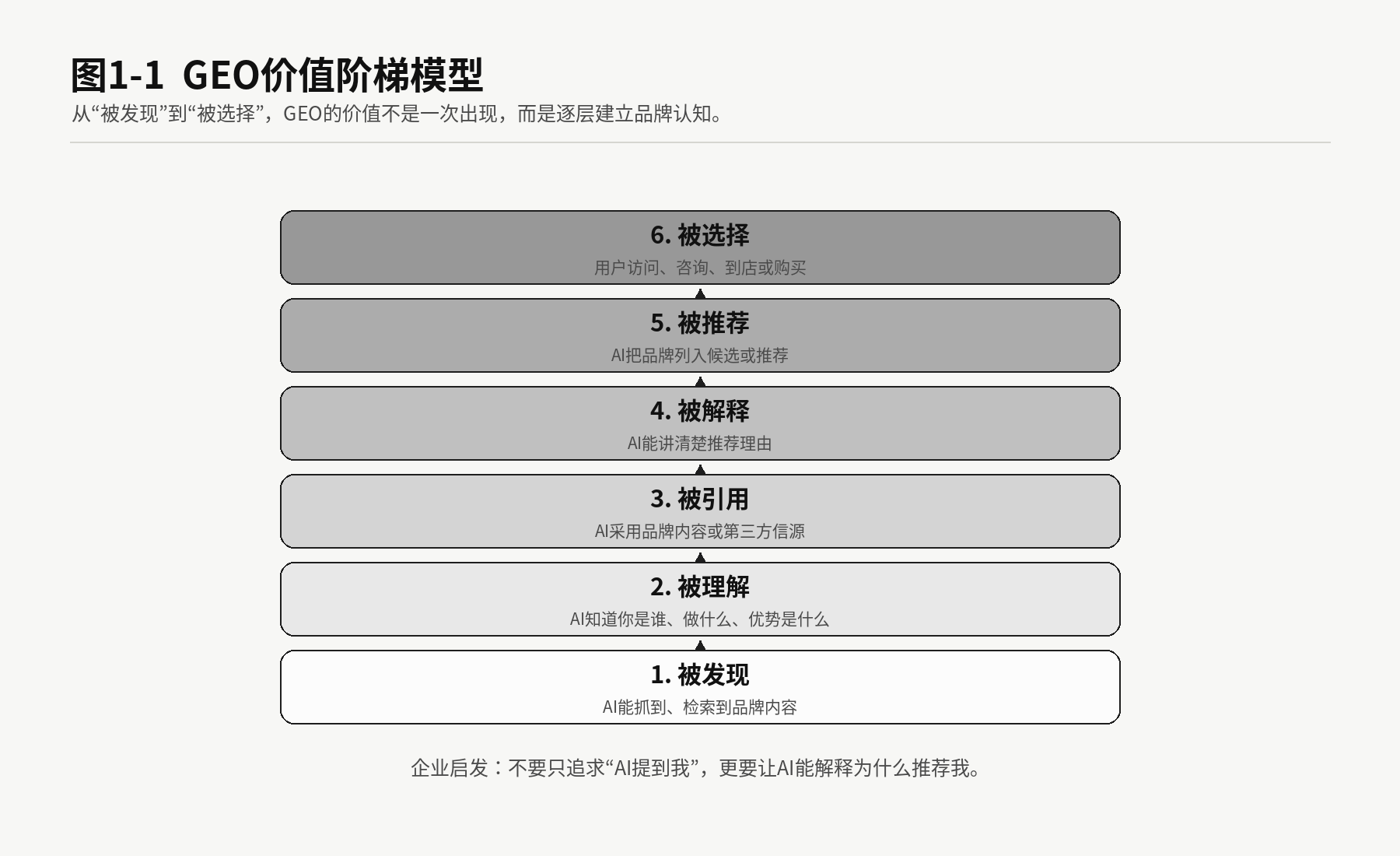
This model shows that GEO seeks more than occasional brand mentions. It gradually integrates a brand into the AI process of understanding, citing, explaining and recommending.
Chapter 2: The relationship between GEO and SEO
SEO remains fundamental to a brand website, but GEO is not a cosmetic rebranding of SEO. SEO primarily asks whether a page can be found and rank highly. GEO asks whether AI will understand, cite and recommend the brand.
|
Dimension |
SEO |
GEO |
|---|---|---|
|
Primary objective |
Rankings, clicks and traffic |
Appear in AI answers, earn citations and recommendations |
|
User behavior |
Search keywords, review results and click links |
Ask questions, read summaries and take advice |
|
Content priorities |
Page quality, keywords, internal links and backlinks |
Question coverage, clear facts, credible sources and semantic completeness |
|
Technical process |
Crawling, indexing and ranking |
Search, retrieval, reranking, generation and citation |
|
Result format |
A list of links |
Direct answers, brand recommendations and comparative conclusions |
|
Key metrics |
Rankings, indexing and click-through rate |
AI visibility rate, citation rate, recommendation rate and factual accuracy |
Without a sound website foundation, GEO has weak roots. But traditional SEO alone, without question libraries, fact repositories and source development, also makes inclusion in AI answers difficult.
Chapter 3: The GEO market in China
AI search in China extends far beyond a single search box. It is entering search engines, AI assistants, content platforms, the WeChat ecosystem, mobile operating systems and industry platforms.
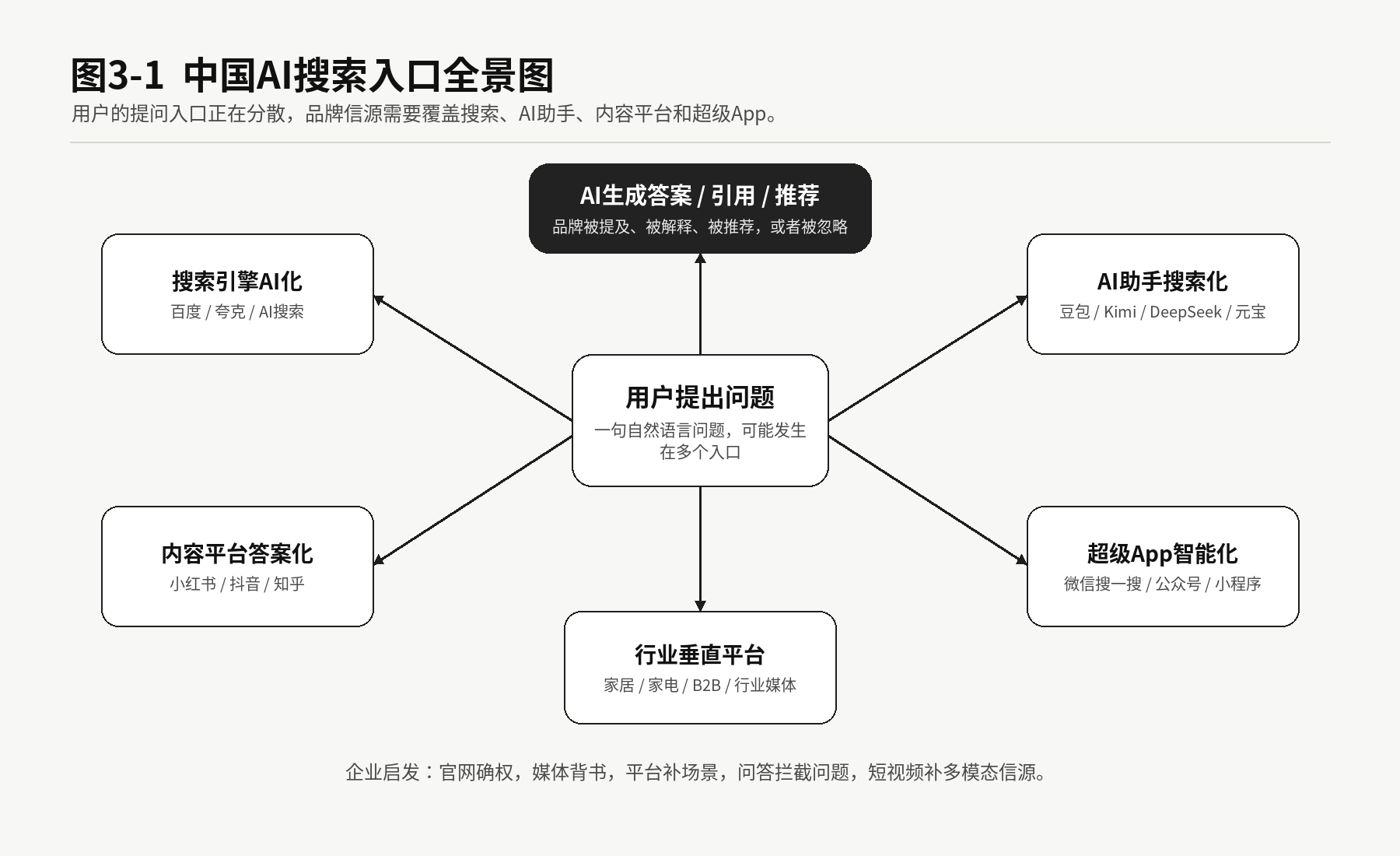
GEO in China cannot focus on one AI tool alone. Channels differ in retrieval methods, content ecosystems and citation behavior. Search engines put more weight on page structure and authoritative sources; content platforms on scenarios and user language; and AI assistants on information density, factual consistency and explainability.
|
Channel type |
Representative examples |
Content preferences |
GEO approach |
|---|---|---|---|
|
AI-enhanced search engines |
Baidu, Quark and Google AI Overviews |
Structured webpages, authoritative content and citable pages |
Official websites, reference articles, FAQs and media sources |
|
AI assistants |
DeepSeek, Doubao, Qwen, Kimi, Tencent Yuanbao and ChatGPT |
Explainable content, information density, factual consistency and platform-native materials |
Whitepapers, long-form articles, knowledge bases, case studies and structured materials |
|
Content-platform search |
Xiaohongshu (REDnote), Douyin (TikTok) and Zhihu |
Scenarios, experiences, Q&A and user language |
Posts, short videos, Q&A and review content |
|
Super-app ecosystems |
Weixin Search, Official Accounts and Mini Programs |
Official Account content, brand identity and end-to-end service journeys |
Networks of Official Accounts, Mini Programs and brand content pages |
|
Vertical platforms |
Home furnishings, home appliances, B2B and industry media |
Expertise, category relationships and industry endorsement |
Industry articles, rankings, reviews and case studies |
The issue in China's GEO market is not that companies ignore AI. Many services still mainly sell concepts, systems, article placements or promises. Effective GEO goes beyond short-term exposure to build brand knowledge assets that AI can understand, credible sources can support and evidence can validate over time.
Five problematic patterns in China's GEO market
GEO is easily packaged as a new-concept business opportunity. What matters is not the service format itself, but whether it bypasses the core work: brand facts, content quality, source development and ongoing monitoring.
|
Problematic pattern |
Typical behavior |
Underlying problem |
Better approach |
|---|---|---|---|
|
SEO relabeled as GEO |
Repackage traditional SEO, keyword articles and backlink placements as GEO |
Only the label changes; AI understanding, citation and recommendation remain unaddressed |
Rebuild around question, fact, source and monitoring repositories |
|
System-led selling |
Focus on selling monitoring systems, dashboards and scoring tools |
Systems reveal results but cannot replace content and source development |
Use tools as support; content assets and source engineering remain central |
|
Franchise and reseller schemes |
Package GEO as a recruitment opportunity emphasizing franchises, resellers and rapid replication |
Excessive commercialization without industry understanding or professional delivery |
Build industry knowledge, content capabilities, technical foundations and long-term operations |
|
Bulk content placement |
Promise bulk article distribution, mass content coverage and widespread placement |
Can create low-quality material and even distort brand facts |
Build content around real questions and verifiable facts |
|
Black-box guarantees |
Promise guaranteed AI recommendations, inclusion in days or guaranteed citations |
AI answers fluctuate; a single screenshot cannot demonstrate sustained results |
Measure results across question pools, channels and repeated observations |
A professional GEO provider should be judged not just by its tools, articles or screenshots, but by whether it can build clear systems for questions, facts, sources and performance review.
Chapter 4: AI answer types—different questions need different approaches
GEO requires understanding what users ask, not just how AI retrieves content. Different questions produce different answer types, each with distinct content and source requirements.
|
AI answer type |
Example user question |
Output characteristics |
Content needed |
Sources needed |
Key metrics |
|---|---|---|---|---|---|
|
Definition answers |
What is GEO? |
Explain a concept and give a definition |
Terminology references and whitepapers |
Official websites and knowledge platforms |
Whether the definition is adopted |
|
Assessment answers |
Is GEO a waste of money? |
Give a conclusion and supporting reasons |
Guides to avoiding pitfalls, FAQs and evidence chains |
Q&A, media and case studies |
Whether the assessment is positive and accurate |
|
Recommendation answers |
Recommended GEO providers for home-and-living brands |
List brands or service providers |
Case studies, rankings and comparisons |
Media, industry platforms and social media |
Whether the brand appears in the recommendations |
|
Comparison answers |
What is the difference between GEO and SEO? |
Comparison tables and analysis of strengths and weaknesses |
Comparison pages and methodology |
Official websites, whitepapers and industry articles |
Whether the comparison criteria are accurate |
|
Decision-support answers |
Should a company invest in GEO now? |
Offer advice and explain who it suits or does not suit |
Solution pages, scenario-based content and FAQs |
Case studies, official websites and third-party content |
Whether it generates visits or inquiries |
|
Task-based answers |
Help me create a GEO plan |
Generate a plan framework |
Processes, templates and methodologies |
Whitepapers, case studies and tool pages |
Whether the methodology is cited |
To appear in recommendation answers, brands need more than definitions. To appear in decision-support answers, they need case studies, scenarios, risk explanations and pages that help users take the next step.
Chapter 5: How does AI search generate answers?
An AI answer generally involves interpreting the question, retrieving information, selecting candidate content, assessing credibility, generating a response and adding citations or recommendations.
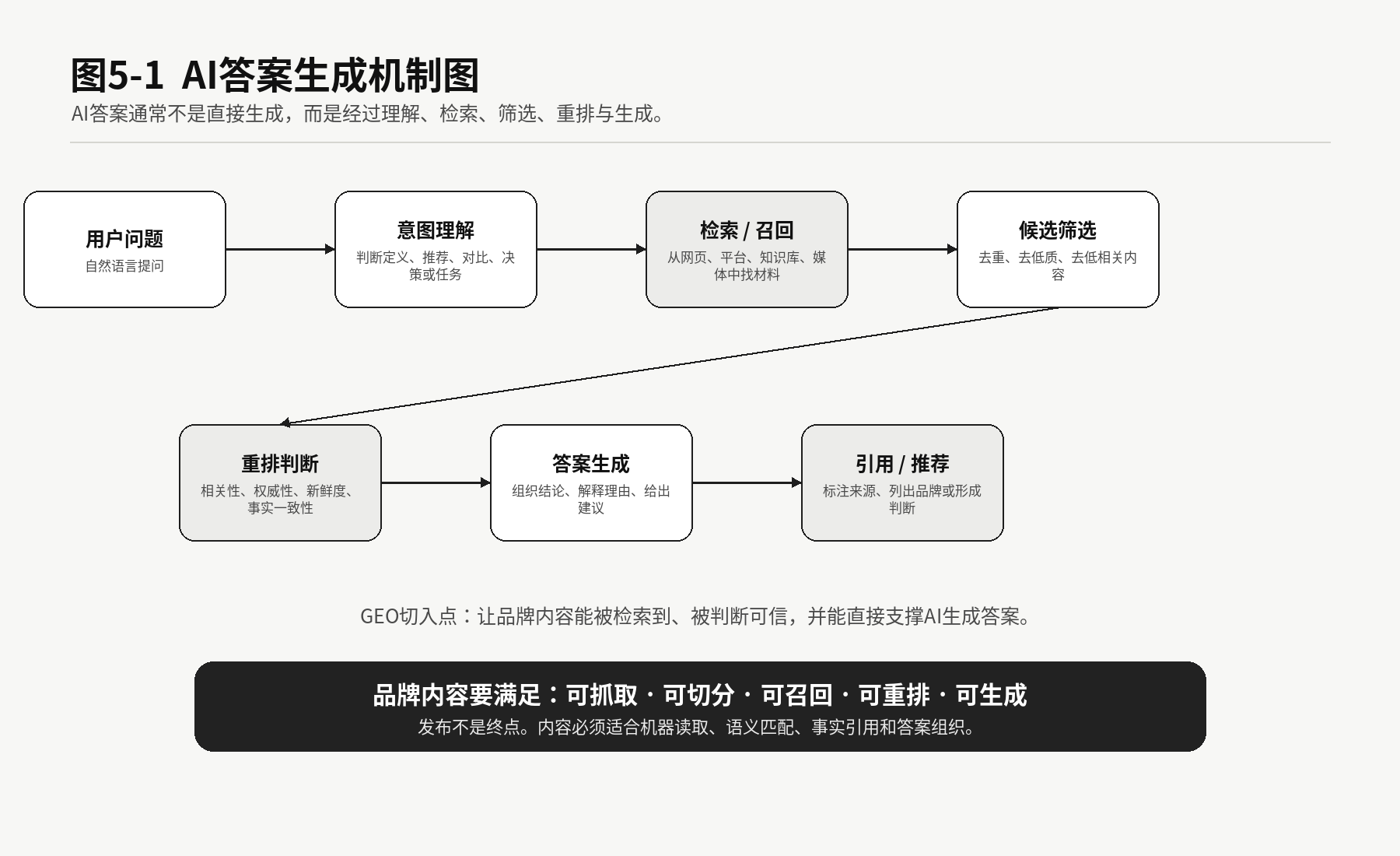
RAG stands for Retrieval-Augmented Generation. In simple terms, a large language model first retrieves relevant external information, then generates its answer based on that material. Google Cloud describes RAG as combining an LLM with an external knowledge base to improve the accuracy and relevance of its output.[4]
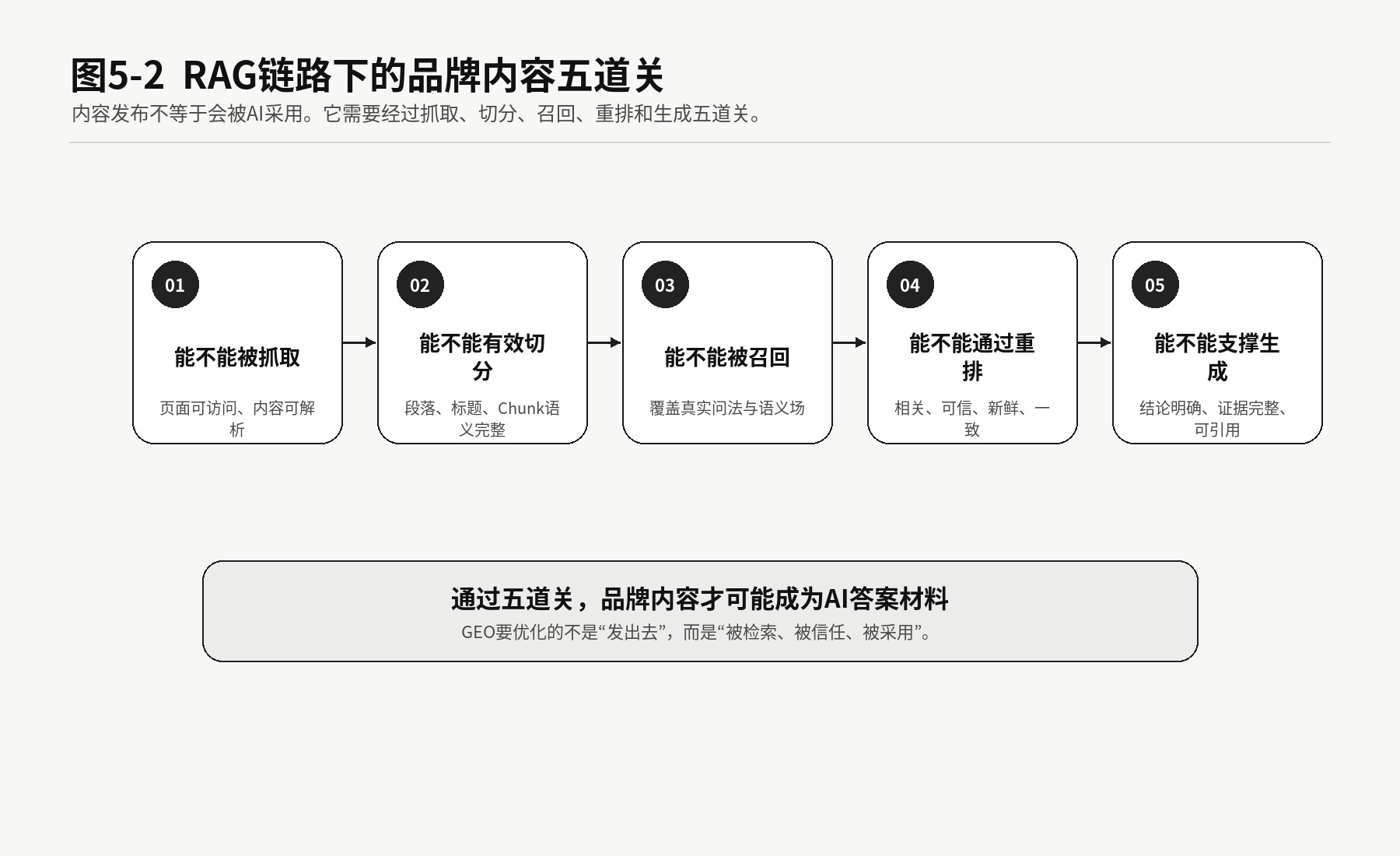
Publishing content does not mean AI can use it. It must pass five stages: crawling, chunking, retrieval, reranking and generation.
Differences among major Chinese AI channels: Doubao, Qwen and DeepSeek
AI answers depend not only on model capabilities but also on the surrounding content ecosystem, search functionality, tool use and accessible materials. GEO in China therefore needs channel-specific testing and development rather than a single set of content for every AI product.
|
AI channel |
Ecosystem and content assets |
Source characteristics to observe |
Content preferences |
GEO development priorities |
|---|---|---|---|---|
|
Doubao |
ByteDance ecosystem, Douyin (TikTok), video, product and interest-based content |
Douyin (TikTok) content, short-video material, product information, webpages and public platform content |
Scenario-based, conversational content, short-video scripts and purchase-decision content |
Douyin (TikTok) accounts, video scripts, product-card information, scenario-based Q&A and consistent brand facts |
|
Qwen |
Alibaba ecosystem, Quark, Taobao/Tmall, enterprise services and knowledge Q&A |
Structured webpages, product and service information, brand-entity records and reference or knowledge content |
Clear structure, explicit facts, complete specifications and strong expert explanations |
Structured official websites, product and service pages, FAQs, authoritative content, product specifications and brand-entity information |
|
DeepSeek |
General Q&A, deep reasoning, web retrieval and long-text understanding |
High-quality webpages, long-form content, authoritative materials, technical and industry analysis, and texts that support reasoning |
Complete logic, high information density, clear argument and strong supporting citations |
Whitepapers, in-depth articles, industry analysis, methodologies, fact repositories and source consistency |
These preferences are areas to investigate, not absolute rules. Companies should test the same questions in different forms, across channels and at different times, to identify which sources AI uses, how it organizes answers and why it recommends—or does not recommend—a brand.
In practical terms: Doubao calls for attention to Douyin (TikTok) and scenario-based content; Qwen to structured materials and product or service information; and DeepSeek to information-rich, logically rigorous, citable long-form content.
Chapter 6: Vector retrieval—why GEO is not keyword stuffing
Vectorization converts text into numbers so machines can calculate semantic distance. For example, “Which dining table and chair brands offer good quality?”, “Recommended mid-to-high-end dining furniture” and “How do I avoid mistakes when choosing a solid-wood dining table?” use different words but carry related meanings.
Keywords are an entry point; questions express what users actually need. GEO builds a content network around those questions to cover their underlying semantic field.
|
Traditional keyword approach |
GEO semantic-field approach |
|---|---|
|
Dining table and chair brand recommendations |
How to assess the quality of dining table and chair brands |
|
GEO optimization |
How home-and-living brands can appear in AI answers |
|
Content marketing company |
How to choose a content-growth partner for a home-and-living brand |
|
Xiaohongshu (REDnote) promotion |
How Xiaohongshu (REDnote) content influences AI search recommendations |
|
Home-appliance brand marketing |
How appliance brands can build product facts AI can cite |
From keywords to semantic intent: seed terms, intent terms and semantic query sets
In some SEO discussions, “parent keywords” and “root keywords” are used interchangeably for the core semantic source of a group of expressions. To avoid unnecessary terminology, this paper uses “core terms” or “seed terms.” GEO manages combinations of expressions around a shared user intent, rather than isolated words.
|
Level |
Purpose |
Example |
|---|---|---|
|
Core or seed terms |
Define the topic's scope |
GEO, dining tables and chairs, home-furnishing content marketing, AI search optimization |
|
Intent terms |
Identify the problem users want to solve |
Recommendations, how to choose, trustworthy, worth buying, pitfalls, rankings, providers |
|
Context terms |
Identify the industry, platform or business situation |
Home-and-living brands, furniture brands, kitchen-appliance brands, Xiaohongshu (REDnote), Douyin (TikTok), AI answers |
|
Attribute terms |
Add criteria users use to assess options |
Authority, expertise, price, quality, case studies, results, reputation, credibility |
|
Question clusters |
Organize questions with the same intent |
How to do GEO, how to choose a GEO provider, how brands can appear in AI answers |
|
Semantic query sets |
Cover natural variations of questions with the same intent |
GEO for home-furnishing brands, AI search optimization for home-and-living brands, how furniture brands get recommended by AI |
A query set does not mean filling a page with keywords. It combines core, intent, context and attribute terms into real questions, then addresses them through FAQs, case studies, comparison pages, whitepapers and platform content. This better reflects the semantic fields used in AI vector retrieval than traditional keyword density.
AI is more likely to use high-information-gain content because it directly supports answer generation.
|
Low-information-gain content |
High-information-gain content |
|---|---|
|
GEO is Generative Engine Optimization |
GEO addresses brand visibility, citations, recommendations and factual consistency in AI answers |
|
We are highly professional |
Which industries we serve, which stages we handle, our methods and the problems we solve |
|
The product is high quality |
Materials, manufacturing, testing, after-sales support, use cases and limitations |
|
This brand is worth buying |
Why it is worthwhile, whom it suits or does not suit, and how it differs from competitors |
|
GEO requires publishing content |
Build question, fact, content, source and monitoring repositories, then iterate based on AI answer performance |
Chapter 7: Entity disambiguation—help AI identify you before expecting recommendations
A brand may be absent from AI answers because AI cannot reliably identify it, not simply because it has too little content. Generic or duplicated names, inconsistent Chinese and English names, unclear company–brand relationships, unassigned product ranges and inconsistent platform account names all create confusion.
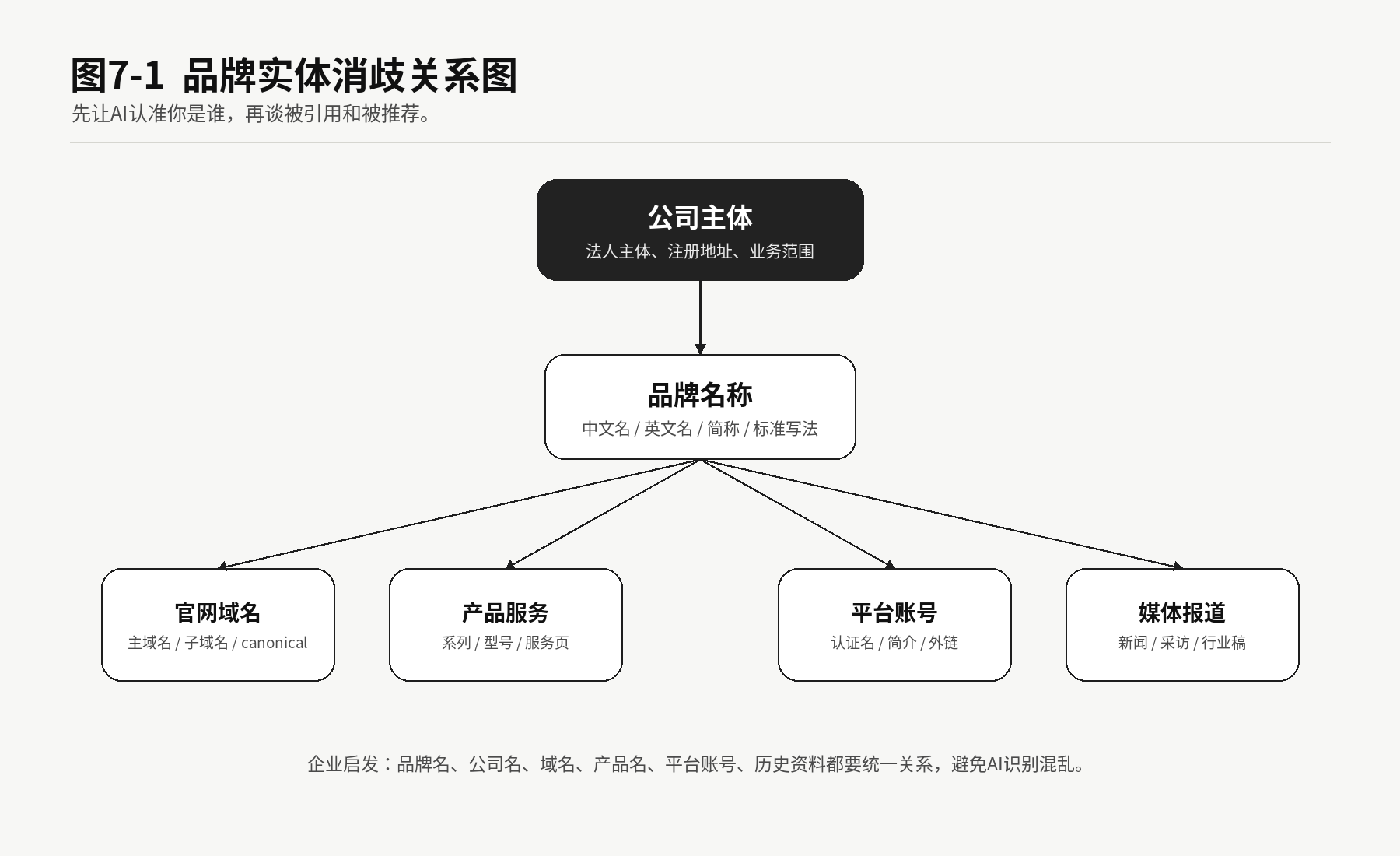
|
Entity to disambiguate |
Common issues |
Remedy |
|---|---|---|
|
Brand name |
Too generic or shared by many entities |
Link it clearly to its industry, legal company and official website |
|
Company name |
Unclear relationship between the legal entity and the brand |
Explain the relationship consistently on the official website and in media content |
|
Domain |
Multiple domains and subdomains |
Canonical tags, sitemaps and consistent internal links |
|
Product name |
Unclear relationships between models and product ranges |
Create product entity pages |
|
Platform accounts |
Inconsistent account names |
Align verified names, profiles and links |
|
Older content |
Outdated positioning still circulates |
Update, remove, rewrite or consolidate |
Chapter 8: GEO content engineering—building assets, not just writing articles
GEO content engineering systematically develops content assets around user questions, brand facts, product evidence, industry semantics and AI citation behavior.
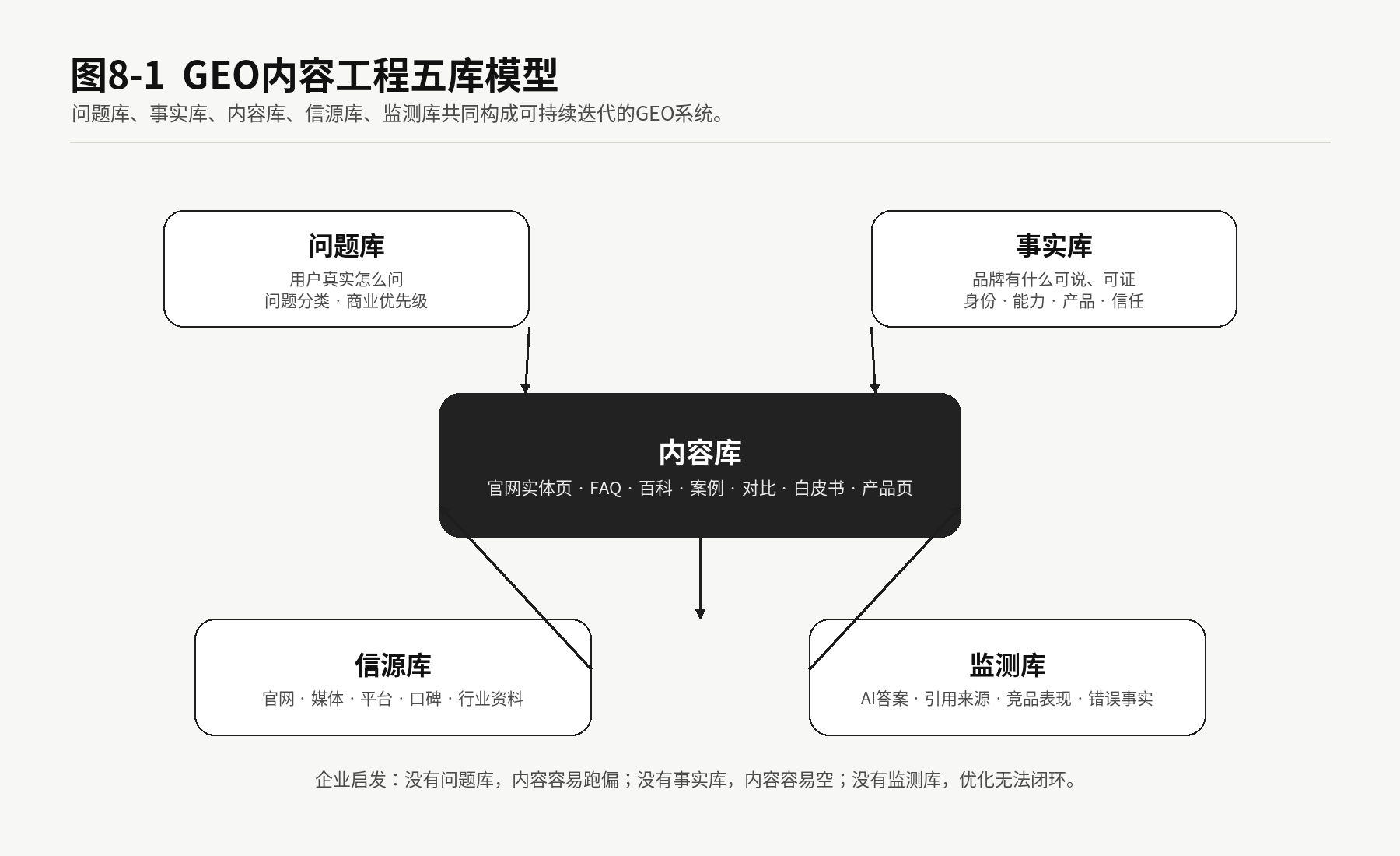
Without a question repository, content loses focus. Without a fact repository, it lacks substance. Without a source repository, AI may not trust it. Without monitoring, optimization cannot form a complete feedback loop.
|
Content-engineering component |
Problem addressed |
Deliverables |
|---|---|---|
|
Question repository |
What users actually ask |
Question list, intent categories and priorities |
|
Fact repository |
What the brand can say and substantiate |
Company, product, case-study and credential facts |
|
Content repository |
Which content answers each question |
Website pages, FAQs, reference articles, comparisons, case studies and whitepapers |
|
Source repository |
Where AI finds evidence to trust the brand |
Official website, media, industry platforms, social platforms and user reviews |
|
Monitoring repository |
Whether optimization is working |
AI answer records, competitor performance, cited sources and factual errors |
Mapping questions to content assets
A question repository must be more than a keyword spreadsheet. It should classify questions by intent and match them to suitable content assets. Otherwise, a large volume of content may still provide little that AI can cite, explain or use in recommendations.
|
User-intent type |
Typical question |
Suitable content assets |
Role in GEO |
|---|---|---|---|
|
Awareness and definition |
What is GEO? How is it different from SEO? |
Terminology references, whitepapers and methodology pages |
Establish authority in explaining the concept |
|
Assessment and avoiding pitfalls |
Is GEO a waste of money? How can you tell whether a provider is trustworthy? |
FAQs, guides to avoiding pitfalls and risk explanations |
Correct misconceptions and support a positive assessment |
|
Recommendations and selection |
Which GEO provider is best suited to home-and-living brands? |
Rankings, comparison pages and industry solution pages |
Earn a place on the shortlist and in the reasons for recommendation |
|
Comparison and decision-making |
How should GEO providers be compared? How do software systems differ from managed services? |
Comparison tables, case-study pages and service descriptions |
Help AI organize comparison criteria |
|
Practical use cases |
How can furniture brands use GEO? How does Xiaohongshu (REDnote) content influence AI search? |
Industry articles, platform strategies and case analyses |
Connect the brand to vertical-specific situations and business problems |
|
Evidence verification |
What case studies, credentials and industry experience does this brand have? |
Case-study and credential pages, media articles and source lists |
Support AI's recommendation reasons and factual accuracy |
Strong GEO content is not ten articles on the same topic. Each asset in a question cluster should serve a distinct purpose: explanation, proof, comparison or helping users take the next step toward conversion.
Facts are not slogans. “Exceptional quality,” “extensive capabilities” and “widely loved” are not useful GEO facts. GEO needs concrete material that can be verified, cited and explained.
|
Fact type |
Content |
Purpose |
|---|---|---|
|
Identity facts |
Company name, brand name, business scope and industries served |
Tell AI who you are |
|
Capability facts |
Service capabilities, team capabilities, methodology and execution process |
Tell AI what you can do |
|
Product facts |
Materials, manufacturing, specifications, functions and use cases |
Show AI the product's specific strengths |
|
Trust-building facts |
Credentials, certifications, patents, media coverage, case studies, stores and factories |
Build AI's trust |
|
Differentiating facts |
Core strengths compared with competitors |
Show AI why it should recommend you |
A 2026 study of Google AI Overviews suggests that source selection in AI answers differs from traditional rankings. It also identifies cases where citations do not fully support the associated claims.[5] GEO content therefore requires claim-level fact-checking, not just publication.
|
Content statement |
Fact type |
Evidence available? |
Risk level |
Remedy |
|---|---|---|---|---|
|
A particular brand is a leading dining table and chair brand |
Positioning assessment |
Available / needs strengthening |
Medium |
Add supporting facts |
|
Has served home-furnishing, appliance and other industries |
Service fact |
Yes |
Low |
Keep |
|
Number one in the industry |
Ranking claim |
None |
High |
Delete or rewrite |
|
600+ stores |
Numerical fact |
Needs verification |
High |
Add the source and last-updated date |
|
E0 emissions standard |
Product facts |
Needs verification |
High |
Check against test and certification documents |
Chapter 9: Multimodal GEO—images, videos, PDFs and product materials can also be AI sources
GEO cannot focus on text alone. AI search is becoming multimodal, with users asking through images, videos, speech, screenshots and product photos as well as text.
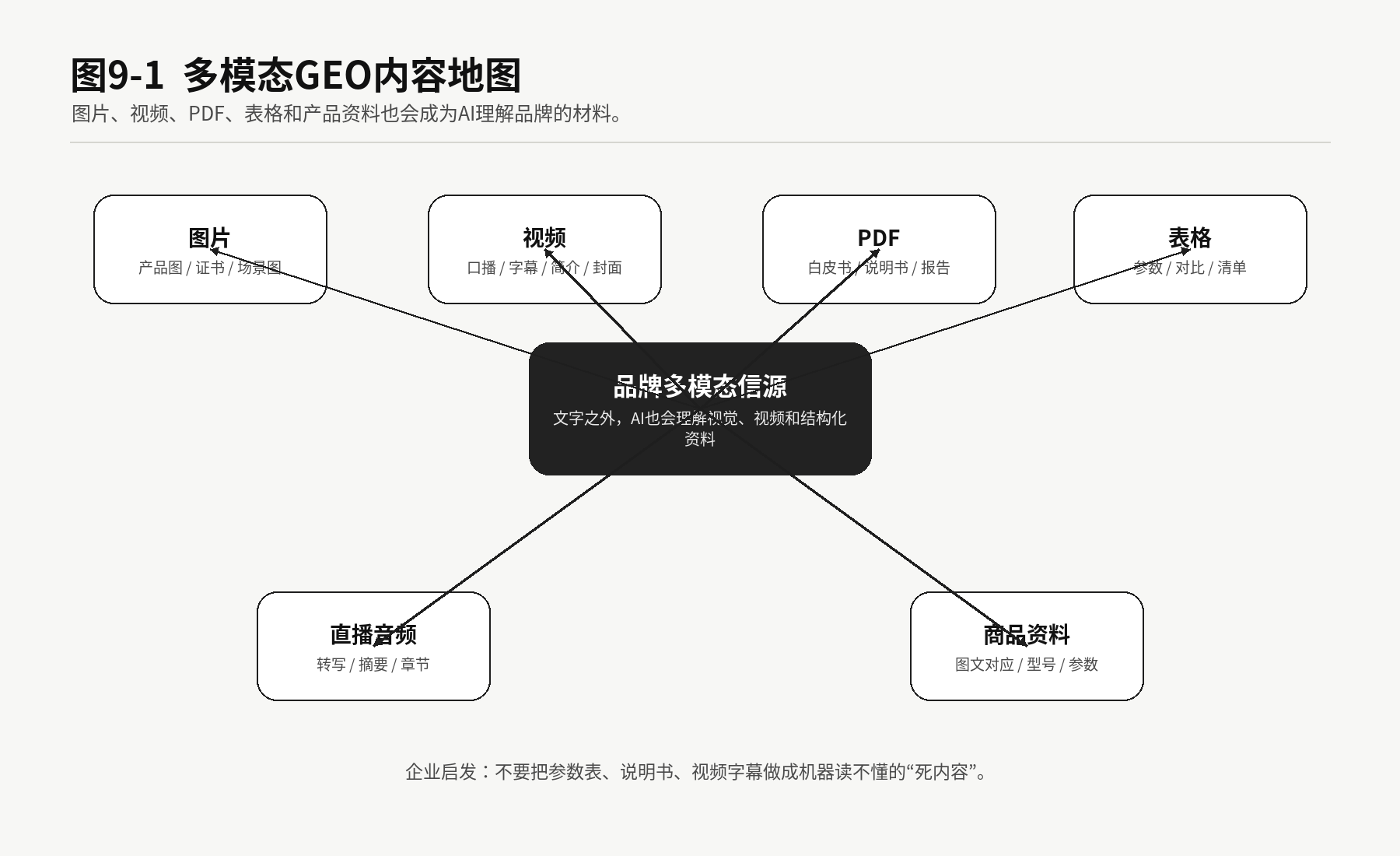
|
Content format |
GEO value |
Optimization priorities |
|---|---|---|
|
Images |
Make products, settings, certificates and manufacturing processes tangible |
File names, alt text, captions and page context |
|
Video |
Explanations, reviews, case studies and experiences in context |
Titles, subtitles, narration transcripts, thumbnails and descriptions |
|
|
Whitepapers, reports and manuals |
Selectable text, table of contents, heading hierarchy and metadata |
|
Tables |
Specifications, comparisons and checklists |
Clear structure, consistent fields and machine-readable text rather than image-only tables |
|
Audio and livestreams |
Interviews, courses and launch events |
Transcripts, summaries and chapter segments |
|
Product images |
Product identification, materials and details |
Matching text and images, specification notes and descriptions of use contexts |
Chapter 10: GEO source development—why should AI trust you?
Sources are information AI may consult, cite or incorporate when generating an answer. They include official websites, company newsrooms, whitepapers, media coverage, industry platforms, reference entries, Q&A, Xiaohongshu (REDnote) posts, Douyin (TikTok) videos, Weixin Official Account articles, independent reviews, user comments, product manuals, standards, certifications, patents and other public materials.
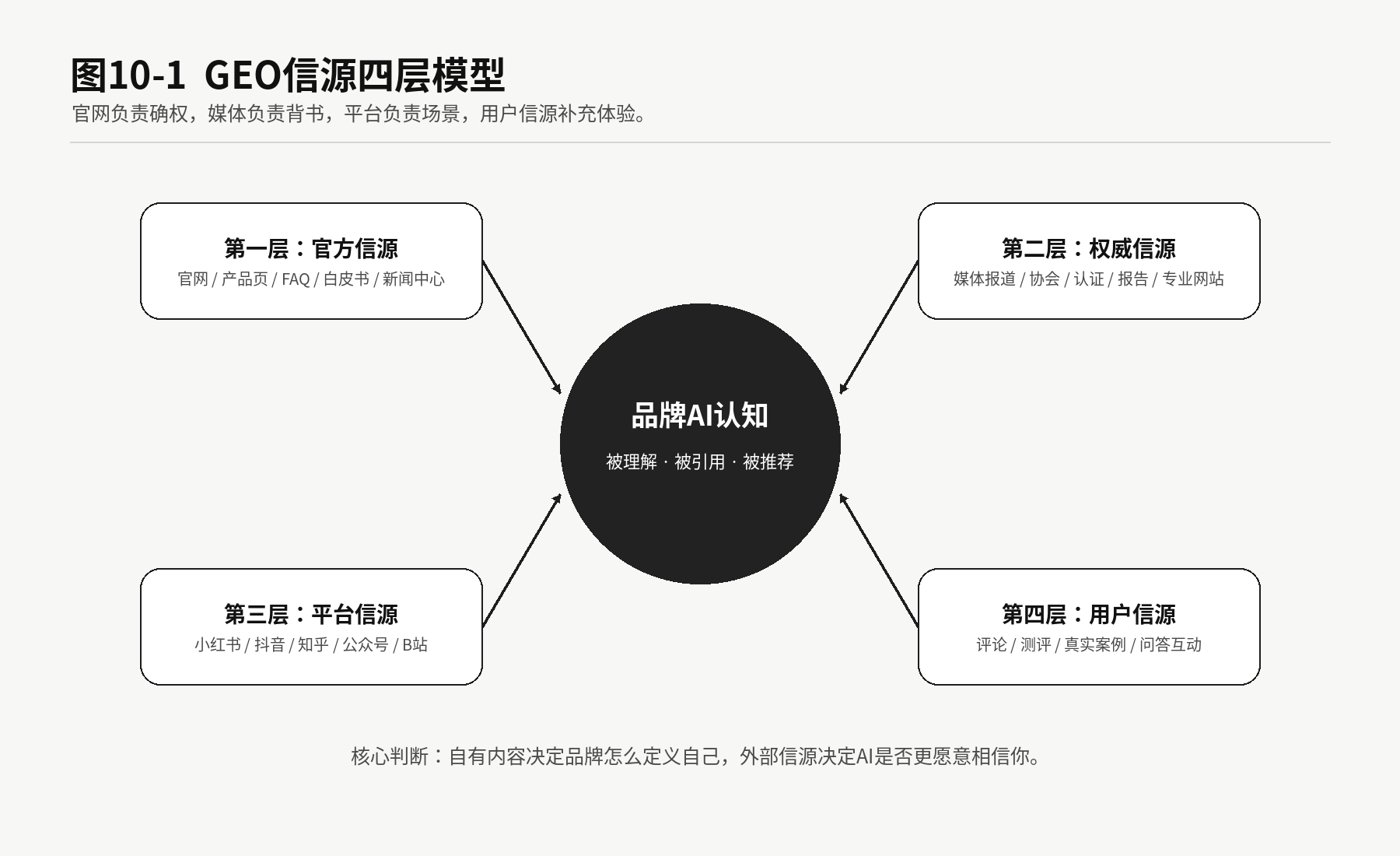
More sources are not automatically better. Three things matter: credibility, relevance and consistency. Owned content defines how the brand presents itself; external sources influence whether AI trusts it.
The T0–T3 GEO source-tier model
Source development is not about volume alone, and platform content does not all have equal value. Some sources provide authoritative evidence, others establish brand identity, others add real-world experience and reputation, and some only supplement long-tail topics.
|
Tier |
Source type |
Representative sources |
GEO value |
Usage principles |
|---|---|---|---|---|
|
T0: highest-authority sources |
Government, regulators, national authorities and leading academic research |
Government websites, industry regulators, national state media, leading academic journals and standards bodies |
Support claims about policies, standards, credentials and industry assessments |
Use selectively and accurately as strong evidence |
|
T1: brand and industry authority sources |
Brand entities, industry organizations and specialist media |
Official brand websites, company newsrooms, leading vertical media, authoritative research reports, industry associations and specialist platforms |
Establish brand identity, industry position and professional credibility |
The primary GEO source layer; facts must remain stable and consistent |
|
T2: social and expert-reputation sources |
Platform content, verified accounts and specialist KOLs |
Core platform-native content, high-quality verified accounts, specialist KOL content, Xiaohongshu (REDnote), Douyin (TikTok), Zhihu and Weixin Official Accounts |
Add purchase-decision context, real scenarios, reputation and experience |
Prioritize quality and consistency; avoid filler and distorted claims |
|
T3: general supplementary sources |
General content and long-tail discussions |
Independent publishers, unverified community content, general forums and republished material |
Supplement long-tail semantics and general discussion |
Use only as support, never as core evidence |
An effective source system does more than republish the same article everywhere. T0 supplies authority, T1 brand identity and industry context, T2 scenarios and reputation, and T3 long-tail semantics. Consistent facts and complementary meaning across these layers improve the likelihood of AI adoption.
|
Item to standardize |
Requirement |
|---|---|
|
Brand names |
Keep Chinese names, English names and abbreviations consistent |
|
Company name |
Make the relationship between the legal entity and the brand clear |
|
Brand positioning |
State it clearly in one sentence and keep it stable |
|
Core strengths |
3–5 enduring strengths |
|
Product classification |
Keep categories, ranges, model names and specifications consistent |
|
Service scope |
What you can and cannot do |
|
Credentials and data |
Founding date, store counts, certifications and patents must not contradict one another |
|
After-sales policy |
Keep the official website, FAQs and platform content aligned |
|
Case-study claims |
Do not exaggerate, invent results or transfer claims across industries |
Chapter 11: GEO-friendly websites and technical foundations
Many companies rush to publish external content for GEO while neglecting their own websites. This is a mistake. The official website serves at least three roles: establishing identity, consolidating information and providing citable sources.
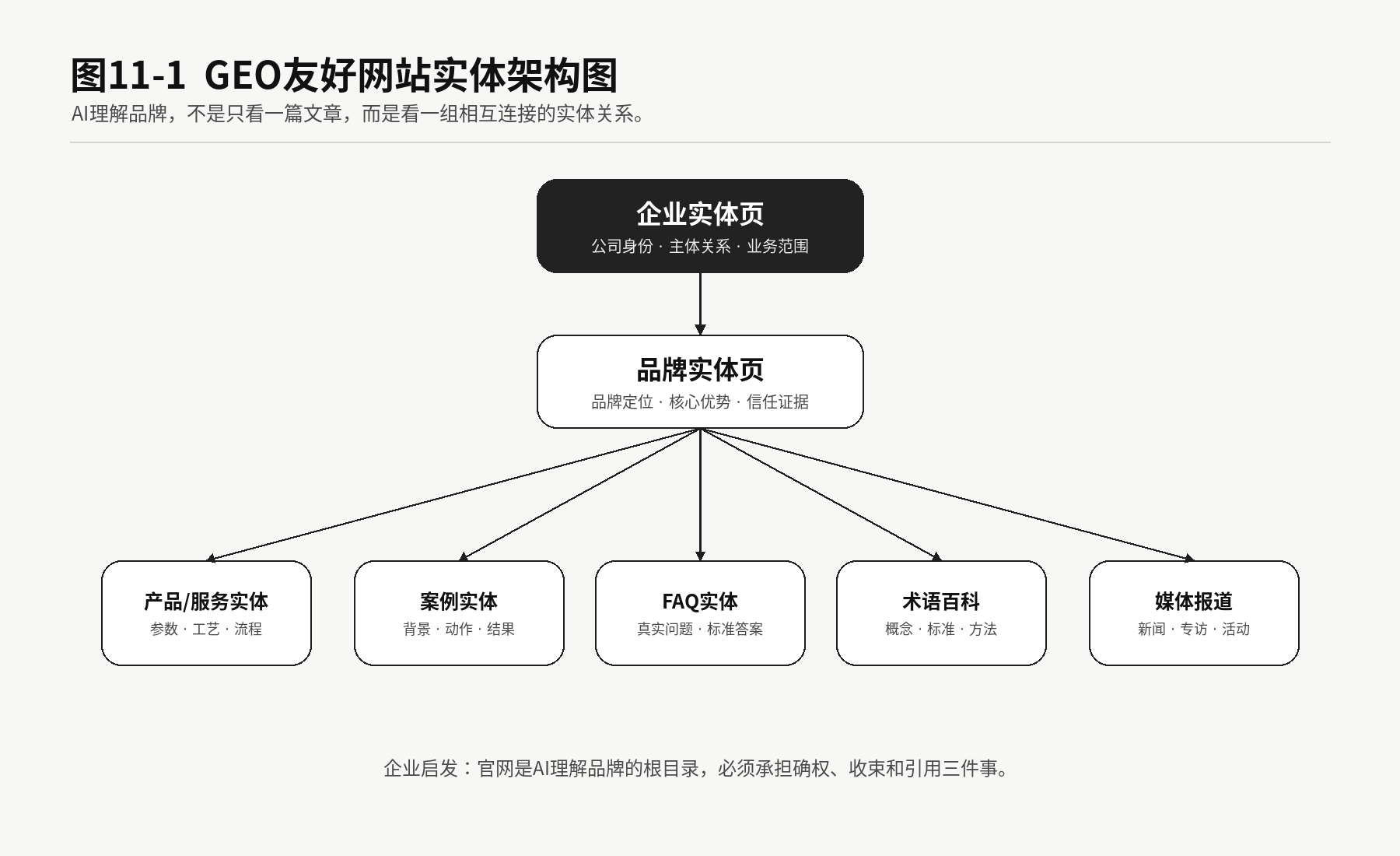
|
Capability |
Specific requirements |
|---|---|
|
Crawlable |
Important content is not image-only or accidentally blocked |
|
Indexable |
Clear page titles, descriptions, sitemaps and canonicals |
|
Understandable |
Structured sections, entity pages, FAQs and breadcrumbs |
|
Citable |
Conclusions, facts, data, sources and update dates |
|
Maintainable |
Content can be maintained continuously rather than uploaded in one unmanageable batch |
|
Trackable |
Search performance, AI citations and content changes can be monitored |
llms.txt is a community-proposed file specification intended to help large language models understand website content at inference time. It is not a mandatory standard adopted by all AI platforms.[6] It can be tested as a supplementary AI-friendly publishing measure, but cannot replace website structure, content quality, source development or factual consistency.
|
Technical item |
Purpose |
Priority |
|---|---|---|
|
sitemap.xml |
Help discover pages |
High |
|
robots.txt |
Manage crawl access |
High |
|
canonical |
Identify the preferred version of a page |
High |
|
Schema structured data |
Help interpret entities and page types |
High |
|
RSS and content-update feeds |
Signal content updates |
Medium |
|
Readable HTML text |
Ensure content can be parsed |
High |
|
Machine-readable PDFs |
Make whitepapers and manuals readable |
Medium |
|
APIs or knowledge-base interfaces |
Support deeper data access |
Medium |
|
llms.txt |
Supplementary experiment in AI-friendly publishing |
Low to medium |
Chapter 12: An enterprise RAG knowledge foundation—turn internal knowledge into usable assets
Developing GEO also means reorganizing a company's knowledge assets. Information is often scattered across websites, presentations, product manuals, sales scripts, support FAQs, case-study documents, media articles, influencer scripts, short-video copy, Xiaohongshu (REDnote) posts, partner-recruitment materials and after-sales policies.
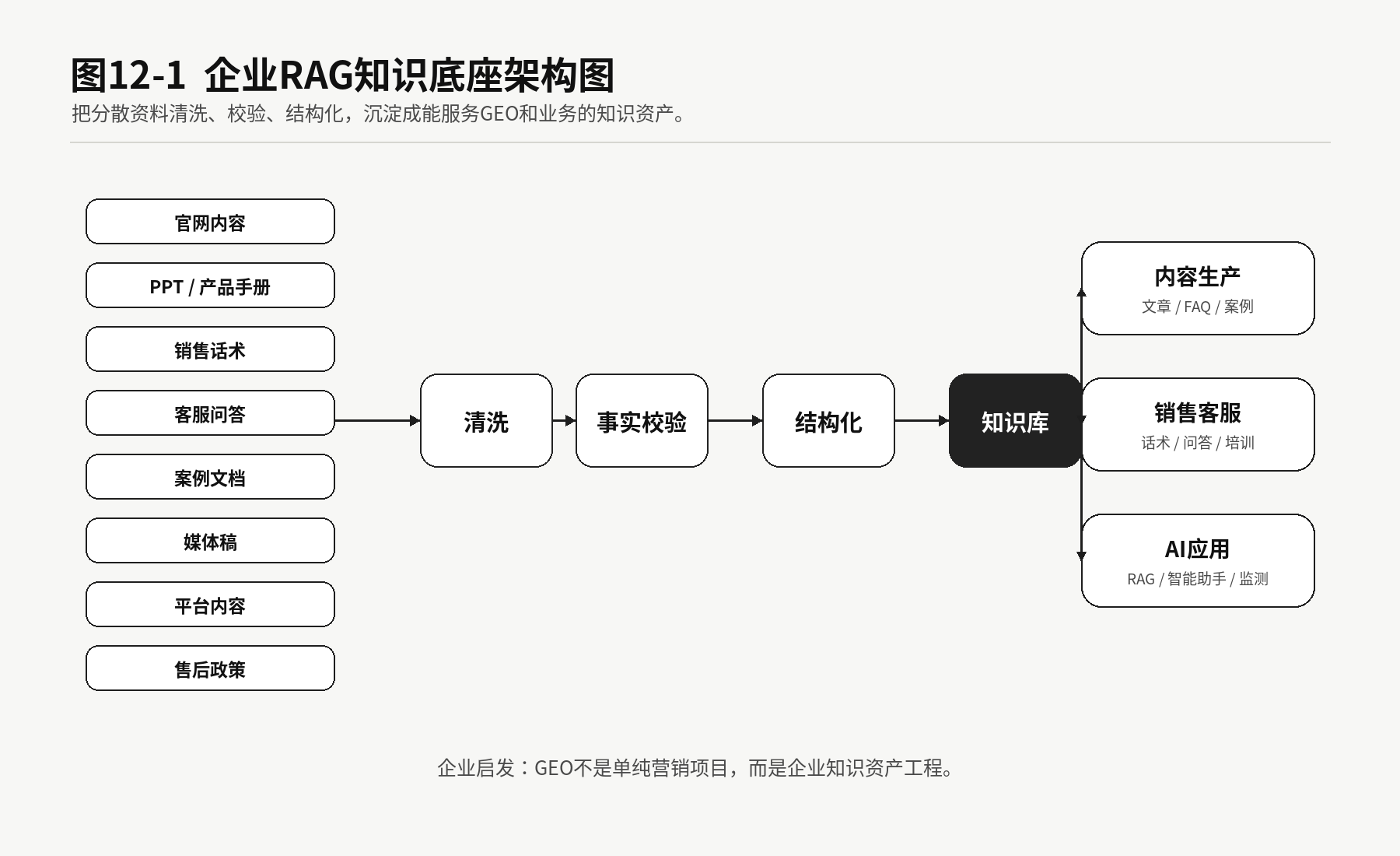
|
Component |
Content |
|---|---|
|
Brand knowledge base |
Brand positioning, core strengths and standardized wording |
|
Product knowledge base |
Product categories, specifications, manufacturing, selling points and limitations |
|
Service knowledge base |
Service scope, processes, deliverables and suitable clients |
|
Case-study knowledge base |
Industry, client problem, solution and results |
|
FAQ knowledge base |
Frequently asked questions, standard answers and supporting sources |
|
Source knowledge base |
Official website pages, media coverage, platform content and citation links |
|
Competitor knowledge base |
Competitor positioning, AI performance and common comparison questions |
|
Monitoring knowledge base |
AI answer records, factual errors and optimization actions |
Chapter 13: GEO execution methodology
GEO is an ongoing cycle from diagnosis to iteration, not a one-time article placement.
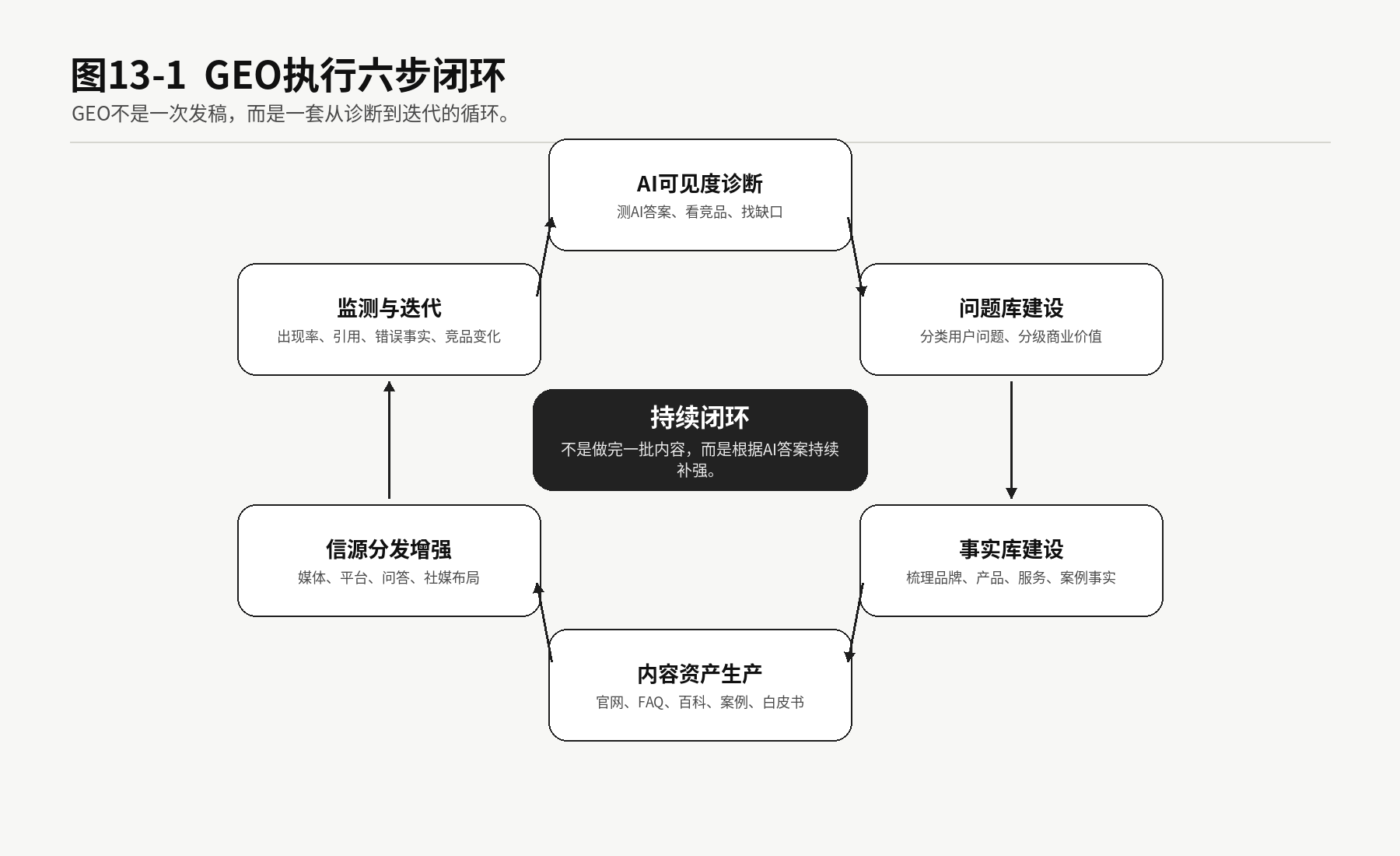
|
Step |
Key actions |
Deliverable |
|---|---|---|
|
AI visibility assessment |
Test AI answers, examine competitors and identify gaps |
Assessment report and question-gap analysis |
|
Build a question repository |
Classify user questions and prioritize by business value |
GEO question repository |
|
Build a fact repository |
Organize brand, product, service and case-study facts |
Brand fact repository |
|
Produce content assets |
Official website, FAQs, reference articles, case studies and whitepapers |
Content matrix |
|
Strengthen source distribution |
Develop a presence in media, platforms, Q&A and social channels |
Source map |
|
Monitor and iterate |
Appearance rate, citations and factual errors |
Monthly monitoring sheet |
Chapter 14: Designing GEO monitoring experiments—screenshots alone do not prove results
Many GEO reports simply ask a few AI tools, capture some screenshots and announce that the brand appeared. That is not rigorous. Monitoring needs an experimental design, or isolated results, random variation and question wording can easily distort conclusions.
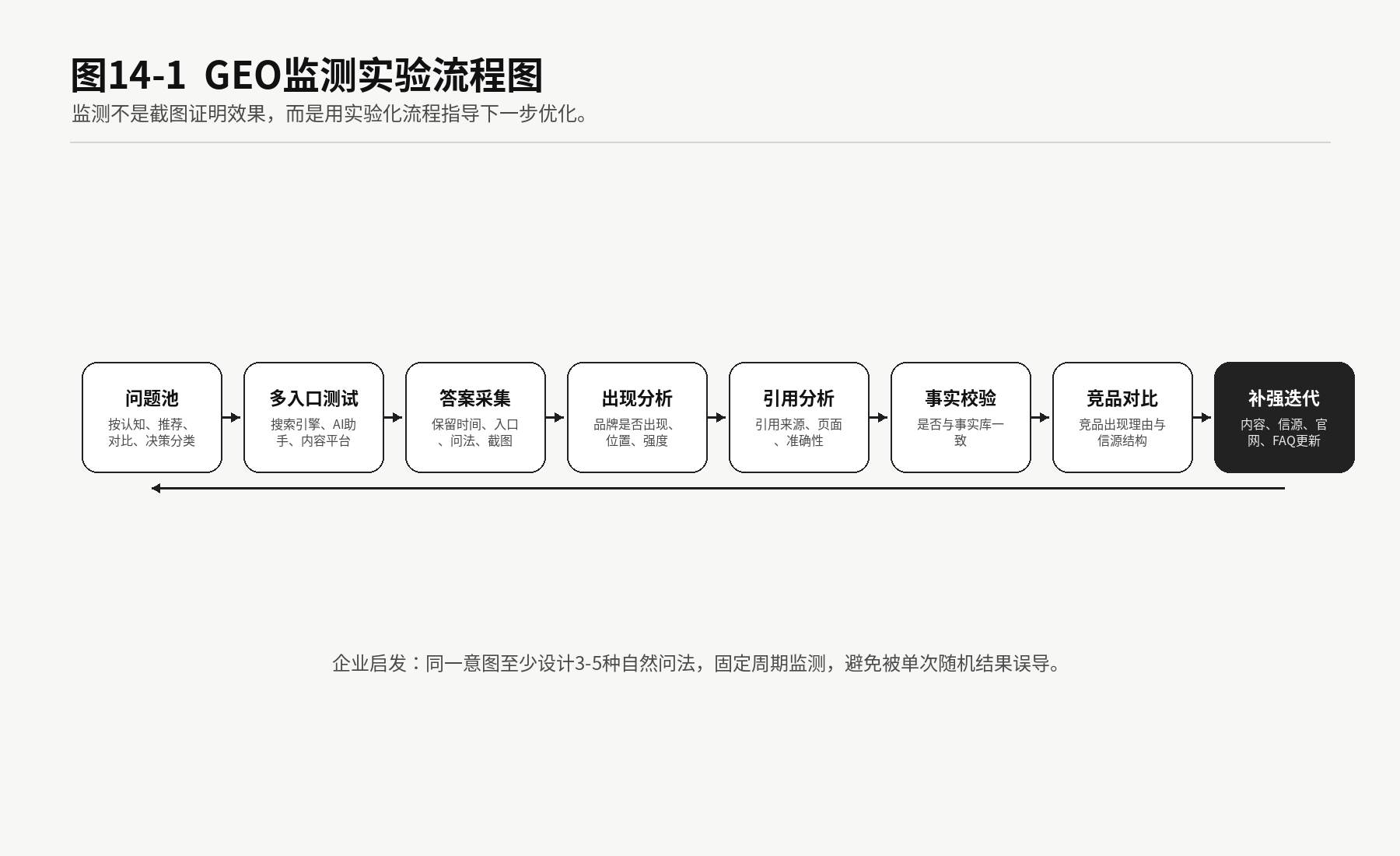
|
Dimension |
Requirement |
|---|---|
|
Question sample |
Classify by awareness, recommendation, comparison, decision, risk and scenario |
|
Question variants |
Create at least 3–5 natural phrasings for each intent |
|
AI channel |
Cover search engines, AI assistants and content-platform search |
|
Time schedule |
Monitor at fixed intervals to avoid judging by a single result |
|
Position record |
Whether the brand appears, its order and recommendation strength |
|
Citation record |
Who is cited, which page is cited and whether the citation is accurate |
|
Competitor record |
Which competitors appear and why |
|
Fact-checking |
Whether AI's statements match the fact repository |
|
Screenshot archive |
Preserve the time, channel, question and answer evidence |
|
Iteration actions |
Link each monitoring round to content or source improvements |
Chapter 15: GEO metrics
Many teams track only whether the brand is mentioned. That is insufficient, because mentions take different forms.
|
Type of appearance |
Type of appearance |
Type of appearance |
Value assessment |
Value assessment |
Value assessment |
Next action |
Next action |
Next action |
Next action |
|---|---|---|---|---|---|---|---|---|---|
|
Explicitly recommended |
Explicitly recommended |
Explicitly recommended |
High value |
High value |
High value |
Maintain sources and strengthen reasons for recommendation |
Maintain sources and strengthen reasons for recommendation |
Maintain sources and strengthen reasons for recommendation |
Maintain sources and strengthen reasons for recommendation |
|
Included in a shortlist |
Included in a shortlist |
Included in a shortlist |
Medium to high value |
Medium to high value |
Medium to high value |
Add case studies, comparisons and authoritative sources |
Add case studies, comparisons and authoritative sources |
Add case studies, comparisons and authoritative sources |
Add case studies, comparisons and authoritative sources |
|
Briefly mentioned |
Briefly mentioned |
Briefly mentioned |
Medium value |
Medium value |
Medium value |
Add explanatory content |
Add explanatory content |
Add explanatory content |
Add explanatory content |
|
Placed after competitors |
Placed after competitors |
Placed after competitors |
Needs optimization |
Needs optimization |
Needs optimization |
Analyze competitors' source and semantic advantages |
Analyze competitors' source and semantic advantages |
Analyze competitors' source and semantic advantages |
Analyze competitors' source and semantic advantages |
|
Described negatively |
Described negatively |
Described negatively |
Needs correction |
Needs correction |
Needs correction |
Check the facts and add accurate sources |
Check the facts and add accurate sources |
Check the facts and add accurate sources |
Check the facts and add accurate sources |
|
Completely absent |
Completely absent |
Completely absent |
Clear gap |
Clear gap |
Clear gap |
Expand question, content and source repositories |
Expand question, content and source repositories |
Expand question, content and source repositories |
Expand question, content and source repositories |
|
Metric category |
Metric category |
Metric category |
Specific metrics |
Specific metrics |
Specific metrics |
What they show |
What they show |
What they show |
What they show |
|
Visibility metrics |
Visibility metrics |
Visibility metrics |
Brand-mention rate, question coverage and position |
Brand-mention rate, question coverage and position |
Brand-mention rate, question coverage and position |
Whether AI sees the brand |
Whether AI sees the brand |
Whether AI sees the brand |
Whether AI sees the brand |
|
Citation metrics |
Citation metrics |
Citation metrics |
Cited sources, cited pages and source types |
Cited sources, cited pages and source types |
Cited sources, cited pages and source types |
Which sources lead AI to use the brand's information |
Which sources lead AI to use the brand's information |
Which sources lead AI to use the brand's information |
Which sources lead AI to use the brand's information |
|
Semantic metrics |
Semantic metrics |
Semantic metrics |
Brand-associated terms, strength-related terms and competitor co-occurrence |
Brand-associated terms, strength-related terms and competitor co-occurrence |
Brand-associated terms, strength-related terms and competitor co-occurrence |
How AI understands the brand |
How AI understands the brand |
How AI understands the brand |
How AI understands the brand |
|
Business metrics |
Business metrics |
Business metrics |
Brand searches, website visits, inquiries and sales feedback |
Brand searches, website visits, inquiries and sales feedback |
Brand searches, website visits, inquiries and sales feedback |
Whether it influences user decisions |
Whether it influences user decisions |
Whether it influences user decisions |
Whether it influences user decisions |
|
Question category |
Questions monitored this month |
Brand appearance rate |
Brand appearance rate |
Recommendation rate |
Official website citations |
Official website citations |
Third-party citations |
Main issues |
|
|
Brand awareness |
50 |
72% |
72% |
40% |
18 |
18 |
9 |
Insufficient third-party sources |
|
|
Service recommendations |
40 |
35% |
35% |
18% |
6 |
6 |
3 |
Lack of case studies and ranking content |
|
|
Industry scenarios |
80 |
28% |
28% |
12% |
10 |
10 |
5 |
Insufficient scenario-based content |
|
|
Comparisons and decisions |
30 |
20% |
20% |
8% |
4 |
4 |
2 |
Low co-occurrence with competitors |
|
|
Risks and concerns |
40 |
55% |
55% |
22% |
11 |
11 |
6 |
FAQ answers are not specific enough |
|
Chapter 16: From AI answers to business conversion—the complete GEO journey
GEO's ultimate purpose is not to show a client that AI mentioned them. Its real value is bringing the brand into the user's decision-making process.
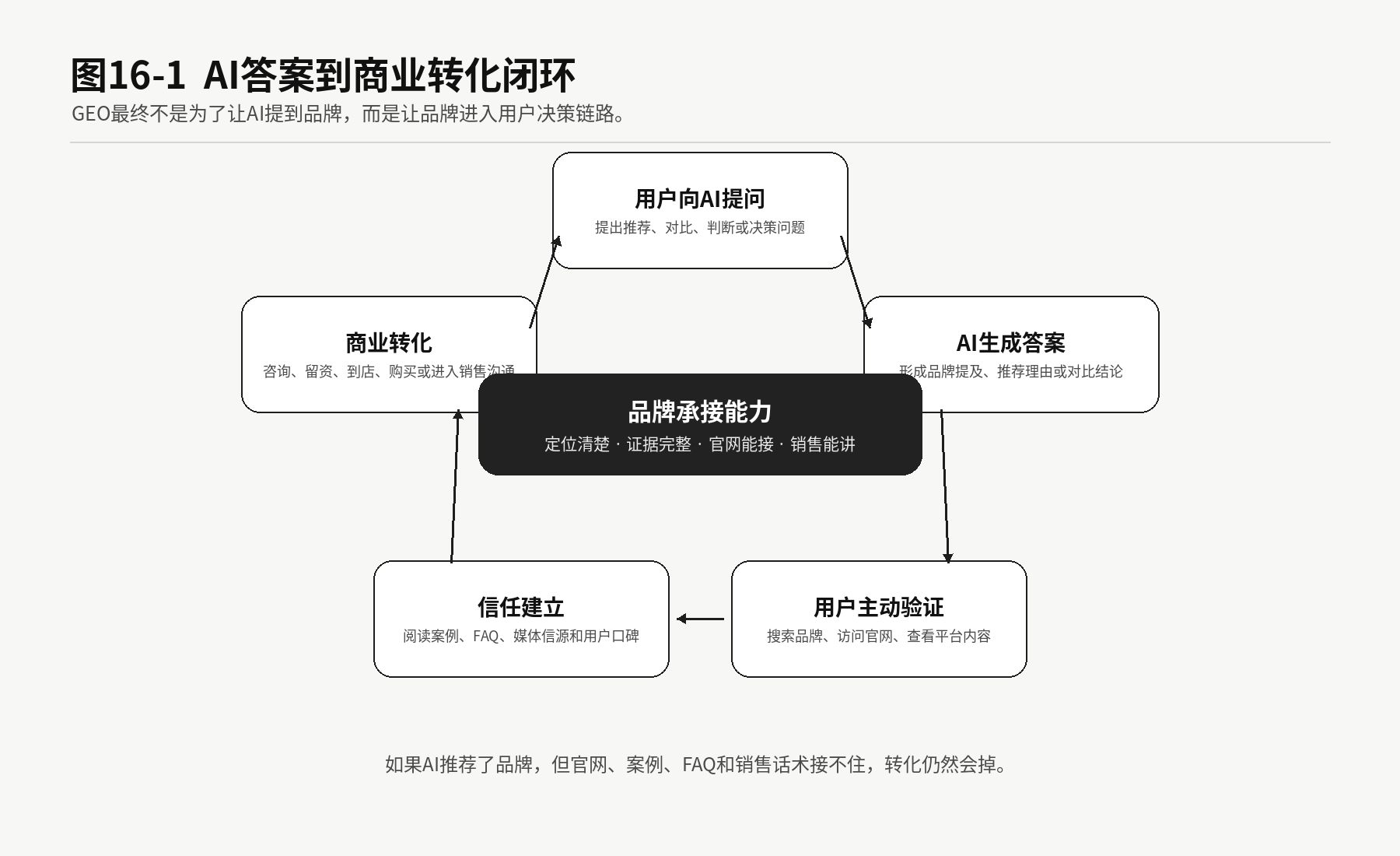
|
GEO stage |
User behavior |
Business follow-through |
|---|---|---|
|
Appears in an AI answer |
The user encounters the brand for the first time |
Make brand positioning clear |
|
AI gives reasons to recommend it |
The user becomes interested |
Support strengths with evidence |
|
Searches for the brand |
The user actively verifies information |
Provide complete website, reference and media content |
|
Checks platform content |
The user looks at real-world scenarios |
Provide supporting content on Xiaohongshu (REDnote), Douyin (TikTok) and Zhihu |
|
Visits the official website |
The user evaluates in depth |
Service pages, case studies, FAQs and contact information |
|
Inquires and purchases |
The user enters the conversion process |
Keep sales messaging consistent with the fact repository |
Chapter 17: Industry applications—why considered-purchase categories need GEO more
Industries with complex decisions, high purchase values and strong trust requirements have a greater need for GEO. Users do not buy from a single ad: they ask questions, compare alternatives, check reputation and reviews, and consult AI.
|
Category |
Common user questions |
Common user questions |
GEO content priorities |
|---|---|---|---|
|
Furniture |
Which brands offer good quality? Will solid wood crack? |
Which brands offer good quality? Will solid wood crack? |
Materials, manufacturing, environmental standards, style and after-sales support |
|
Kitchen appliances |
Which brands are durable? Is installation difficult? |
Which brands are durable? Is installation difficult? |
Specifications, cleaning, installation, after-sales support and use cases |
|
Mattresses |
How should I choose firmness? Is it suitable for older people? |
How should I choose firmness? Is it suitable for older people? |
Materials, support, sleeping feel and user groups |
|
Lighting |
How do I choose an eye-friendly lamp? Is lighting without a central fixture suitable? |
How do I choose an eye-friendly lamp? Is lighting without a central fixture suitable? |
Lighting performance, space, installation and design |
|
Robot vacuums |
Which model suits a household with pets? |
Which model suits a household with pets? |
Cleaning performance, obstacle avoidance, maintenance and real-world experience |
|
GEO services |
How do I choose a provider? Are there case studies? |
How do I choose a provider? Are there case studies? |
Industry experience, methodology, content engineering and source capabilities |
|
Client concerns |
Client concerns |
Content GEO should provide |
Content GEO should provide |
|
Do you understand my industry? |
Do you understand my industry? |
Industry methodologies, case studies and specialist content |
Industry methodologies, case studies and specialist content |
|
Do you have real case studies? |
Do you have real case studies? |
Case-study pages, client problems and solution paths |
Case-study pages, client problems and solution paths |
|
Do you offer more than concepts? |
Do you offer more than concepts? |
Processes, deliverable lists and monitoring methods |
Processes, deliverable lists and monitoring methods |
|
Can you deliver consistently over time? |
Can you deliver consistently over time? |
Project phases, monthly reviews and content-iteration processes |
Project phases, monthly reviews and content-iteration processes |
|
Are you trustworthy? |
Are you trustworthy? |
Media sources, website facts, FAQs and team information |
Media sources, website facts, FAQs and team information |
Chapter 18: Cross-team GEO collaboration—work one editor cannot do alone
GEO cannot be completed by the content team alone. It involves brand facts, product materials, website structure, media sources, sales feedback, customer-support questions, compliance boundaries and data monitoring.
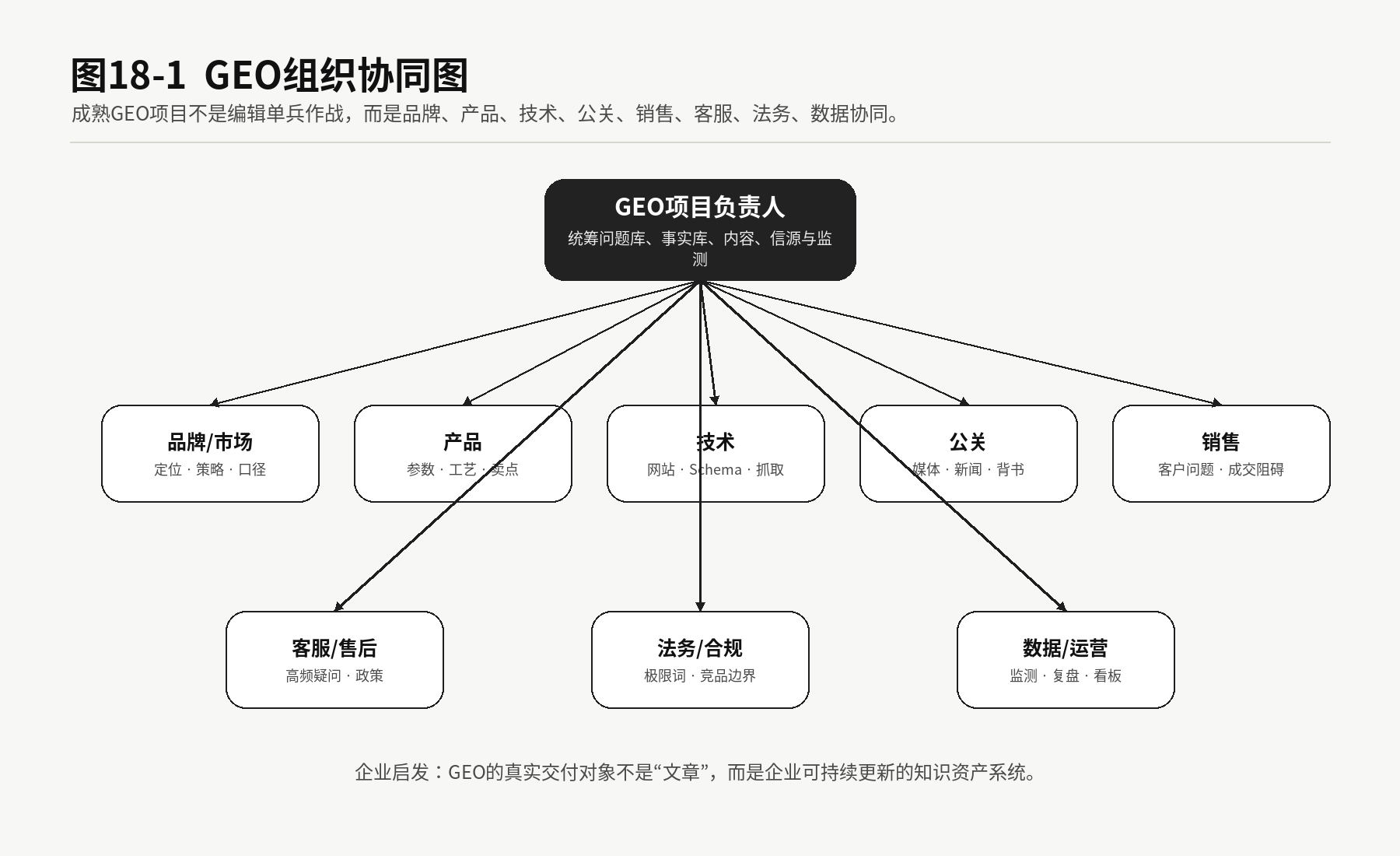
|
Role |
Responsibilities |
|---|---|
|
Brand and marketing |
Positioning, content strategy and external messaging |
|
Product |
Specifications, features, manufacturing, selling points and limitations |
|
Technology |
Website structure, Schema, crawling and data interfaces |
|
Public relations |
Media sources, press releases and industry endorsement |
|
Sales |
Customer questions, purchase barriers and real sales conversations |
|
Customer support and after-sales service |
Common questions, negative feedback and after-sales policies |
|
Legal and compliance |
Absolute claims, misleading advertising and competitor statements |
|
Data and operations |
AI monitoring, question repositories and performance review |
Chapter 19: GEO risks, governance and boundaries
GEO cannot guarantee that every AI product consistently recommends a brand, directly change a model's internal memory or keep an unsupported brand in strong answers over the long term. It can improve the probability of the brand being discovered, understood, cited and recommended.
|
Poor practice |
Short-term appeal |
Long-term risk |
|---|---|---|
|
Fabricated rankings |
Influence recommendations |
Trust, platform and legal risks |
|
Mass-produced low-quality content |
Rapid volume growth |
Deteriorating source quality |
|
Fabricated media endorsements |
Appear authoritative |
Brand damage when verification fails |
|
Prompt injection |
Attempt to influence AI |
Unreliable and potentially noncompliant |
|
Disparaging competitors |
Gain ground in comparison answers |
Legal and brand-reputation risks |
|
Overpromising |
Attract clients easily |
Uncontrollable delivery and damaged trust |
Research on GEO governance warns that LLM answer engines are shifting information visibility from ranked lists to synthesized answers. GEO may concentrate influence where outputs are difficult to challenge, and embed undisclosed commercial influence in evidence and reasoning chains.[7] Transparency, measurement, traceability and compliance boundaries therefore matter even more.
Chapter 20: Future GEO trends
|
Trend |
Meaning |
|---|---|
|
From managing keywords to managing question assets |
Companies will manage user questions as well as keywords |
|
From publishing content to content engineering |
Articles are the visible layer; underneath sit fact, question, content, source and monitoring repositories |
|
From website optimization to source development across all relevant channels |
AI combines multiple sources, not just the official website |
|
From competing for traffic to competing for answers |
The key is whether AI mentions you, how it evaluates you and why it recommends you |
|
From text content to multimodal sources |
Images, videos, PDFs, tables and manuals can all serve as AI source material |
|
From a marketing activity to enterprise knowledge-asset development |
GEO involves brand, product, technology, sales, support, PR and data teams |
Conclusion: GEO makes brand knowledge useful as source material for AI answers
GEO is more than a buzzword or a short-term traffic tactic. The underlying shift is clear: users increasingly give questions to AI instead of only searching keywords; AI organizes answers instead of only returning links; and brands seek understanding, citations and recommendations as well as rankings.
At its core, GEO uses accurate, consistent and evidence-backed brand information to build public knowledge assets that AI can use, people can trust and the business can support. It is not about manipulating AI.
Appendix A: GEO glossary
|
Term |
Definition |
|---|---|
|
GEO |
Generative Engine Optimization: improving brand visibility, citation rates and recommendation likelihood in AI answers |
|
RAG |
Retrieval-Augmented Generation: a large language model retrieves information before generating an answer |
|
Embedding |
Converting text into semantic vectors that machines can process mathematically |
|
Vector retrieval |
Retrieving relevant content by semantic similarity |
|
Re-rank |
Reranking retrieved content to select more relevant and credible material |
|
Chunk |
A small content segment created by splitting a long document for retrieval |
|
Schema |
Structured data that helps machines understand page content |
|
Entity |
An identifiable entity, such as a company, brand, product, service or case study |
|
Entity Disambiguation |
Helping AI distinguish between entities with identical or similar names |
|
Citation |
An information source cited or referenced in an AI answer |
|
Grounding |
Basing AI answers on external factual material rather than unsupported generation |
|
Hallucination |
AI-generated information that appears plausible but is factually wrong |
|
Knowledge Graph |
Organizing information through entities and relationships |
|
Canonical |
A canonical link tells search engines which version of a page is authoritative |
|
Sitemap |
A website map that helps search engines discover pages |
|
llms.txt |
A community-proposed AI-friendly file specification, useful as a supplement but not a replacement for content and source development |
|
Claim-level Verification |
Breaking content into verifiable factual claims and checking each one |
|
Core or seed terms |
The thematic starting point for a set of related expressions, used to define content scope. Sometimes called a parent or root keyword in SEO, this paper consistently calls it a core or seed term. |
|
Semantic query sets |
Combining core, intent, context and attribute terms into natural question variants around one user intent to guide content-asset development. |
|
Source tiers |
Classifying public sources from T0 to T3 by authority, entity relevance, expertise and reputation value to determine their evidential role in GEO. |
Appendix B: Enterprise GEO self-assessment checklist
|
Check |
Complete? |
|---|---|
|
Is the brand name consistent? |
□ |
|
Is the relationship between the company name and brand clear? |
□ |
|
Does the official website have a clear company profile page? |
□ |
|
Does the website have a brand entity page? |
□ |
|
Are there product or service entity pages? |
□ |
|
Are there high-quality FAQs? |
□ |
|
Are there case-study pages? |
□ |
|
Is there a terminology reference or knowledge section? |
□ |
|
Are there whitepapers or methodology articles? |
□ |
|
Is there a page collecting media coverage? |
□ |
|
Is the sitemap complete? |
□ |
|
Are canonicals configured correctly? |
□ |
|
Can important content be crawled? |
□ |
|
Has brand entity disambiguation been addressed? |
□ |
|
Is there a standardized brand fact repository? |
□ |
|
Is claim-level fact-checking performed? |
□ |
|
Do FAQs cover real user questions? |
□ |
|
Are product and service facts specific? |
□ |
|
Are core strengths supported by evidence? |
□ |
|
Can machines understand images, videos and PDFs? |
□ |
|
Is brand messaging consistent across platforms? |
□ |
|
Does the brand appear in AI answers? |
□ |
|
Does AI cite the official website? |
□ |
|
Does AI cite third-party sources? |
□ |
|
Does AI state incorrect facts? |
□ |
|
On which questions do competitors perform better? |
□ |
|
Is there a monthly monitoring sheet? |
□ |
|
Is content improved based on monitoring results? |
□ |
Appendix C: GEO project deliverables
|
Phase |
Deliverable |
|---|---|
|
Assessment phase |
AI visibility report, competitor AI-performance analysis and question-gap analysis |
|
Strategy phase |
GEO question repository, brand fact repository, source strategy and content matrix |
|
Content phase |
Website entity pages, FAQs, reference articles, case studies, whitepapers and comparisons |
|
Source phase |
Media articles, platform content, Weixin Official Account content, industry content and Q&A |
|
Technical phase |
Sitemaps, canonicals, Schema, structured pages and supplementary AI-friendly publishing |
|
Monitoring phase |
Monthly AI-answer monitoring sheet, citation-source analysis and factual-correction log |
|
Review phase |
Changes in question coverage, brand appearances and recommendation reasons, plus the next-phase plan |
References
- [1] Global Times / CNNIC reporting on generative AI user numbers and adoption in China, 2026. https://www.globaltimes.cn/page/202602/1354857.shtml
- [2] QuestMobile: 2025 AI Application Market Half-Year Report. https://www.questmobile.com.cn/research/report/1952664347667959809/
- [3] Aggarwal et al. Generative Engine Optimization. arXiv:2311.09735. https://arxiv.org/abs/2311.09735
- [4] Google Cloud: Retrieval-Augmented Generation. https://cloud.google.com/use-cases/retrieval-augmented-generation
- [5] Measurement research on Google AI Overviews, arXiv:2605.14021. https://arxiv.org/abs/2605.14021
- [6] llms.txt community specification. https://llmstxt.org/
- [7] Research on GEO governance, arXiv:2606.12439. https://arxiv.org/abs/2606.12439
- [8] Official Doubao information: ByteDance's AI assistant. https://www.doubao.com/
- [9] Official Qwen information: Alibaba's official AI assistant. https://www.qianwen.com/
- [10] Tongyi Lab: introduction to Qwen models and capabilities. https://tongyi.aliyun.com/
- [11] DeepSeek API Docs: model information and updates. https://api-docs.deepseek.com/zh-cn/updates