When asking AI is faster than searching: how brands can stay visible
When users ask AI directly, brand competition shifts from search rankings to inclusion in answers. The real risk is not a lower ranking but being left out of the candidate answers altogether. Brands need credible content, independent reputation and crawlable structures to rebuild their presence.
Topics
4Summary
When users ask AI directly, brand competition shifts from search rankings to inclusion in answers. The real risk is not a lower ranking but being left out of the candidate answers altogether. Brands need credible content, independent reputation and crawlable structures to rebuild their presence.
When asking AI is faster than searching: how brands can stay visible
A few years ago, this scenario would have been hard to imagine: someone wants an air fryer, opens their phone and, instead of searching Taobao or Baidu for recommendations, asks, “Which air fryers suit a two-person household with a budget under 500?” They receive an organized answer with reasons and comparisons already done for them.
This now happens every day. Whether through ChatGPT, Perplexity or AI summaries appearing in Baidu and Google search results, more people are turning to a conversational model at the final stage of a decision. For brands, this is not a distant trend to watch; it is already quietly changing traffic patterns. However good your content is, if AI never mentions you in its answer, users may never know you existed.
This article explores what that means and what an ordinary brand can do, even without a large team.
1. Where competition moves when search results disappear
The rules of traditional search are familiar: keywords, backlinks and structured markup help you reach the top positions, where users can click through. That logic still matters, but its territory is shrinking. When users see an AI-generated summary above the search results, many never scroll down to the ten blue links.
A subtler change is that AI answers are often synthesized from several sources—perhaps three to five—and rephrased in the model's own words. Even excellent content may reach the user only as a paraphrased, compressed or quietly omitted version of the original.
The issue therefore has two layers: first, does the AI see your content when generating an answer? Second, if it does, will it consider you worth mentioning as a source? Both are essential, and they call for somewhat different approaches.
2. AI selects content differently from search engines
Old-school SEO revolves around matching: the terms users search for should appear on your page, with attention paid to their frequency and placement. This approach largely breaks down with AI, because it is trying to understand meaning rather than merely match strings.
Consider two articles on choosing an espresso machine. The first follows an SEO formula: the title is packed with keywords, and the body repeatedly uses phrases such as “espresso machine recommendations” and “how to choose an espresso machine,” yet offers little structure or meaningful basis for a decision. The second may have a plain title, but immediately explains how budget affects the choice between pump pressure and semi-automatic or fully automatic machines, and what distinguishes home from commercial use. It also gives concrete reasons to choose or reject particular models.
If you were an AI extracting an answer from a pile of material, which article would you prefer to paraphrase? The answer is straightforward: the second has a clear argument, definite points and passages that can be extracted cleanly. The first seems to go in circles.
This is why content optimization involves related disciplines such as Language Model Optimization, Generative Engine Optimization (GEO) and Answer Engine Optimization (AEO). These concepts are related, but their emphases are not identical. All stress that content should be accurate, easy to understand and extract, and able to withstand follow-up questions. Several principles are shared:
Lead with the answer instead of making readers work through three paragraphs of background. Support claims with real data, examples and verifiable details, rather than adjectives alone. Revisit older content to check its accuracy, because outdated information can be little different from incorrect information to AI. And explain one topic thoroughly instead of skimming ten related ones: an article that fully answers a question is more likely to serve as an authoritative source than ten half-finished treatments.
3. Major AI models do have different preferences
Although their underlying principles are similar, AI products behave quite differently when retrieving information and choosing sources to cite. It is worth looking at them separately:
|
Platform |
Information-source characteristics |
Implications for brand content |
|---|---|---|
|
ChatGPT (OpenAI) |
Training data has a defined cutoff; some features can search the web for more recent information |
Both readability and freshness matter; outdated or vague content is easier to overlook |
|
Perplexity |
Relies heavily on live web search, typically lists its sources directly and also incorporates data from platforms such as Reddit and Yelp |
Genuine discussions and reviews on forums and review sites directly affect citation opportunities |
|
Google AI Overviews (powered by Gemini capabilities) |
Appears at the top of search results as an extension of Google's search ecosystem |
Authority built through traditional SEO still matters; structured data and factual content are more readily used in summaries |
|
Claude (Anthropic) |
Favors logically rigorous content from credible sources and treats marketing-like material more cautiously |
Educational, well-supported content without exaggerated claims is relatively more likely to be accepted |
This table is only a rough sketch. AI products evolve rapidly, and today's behavior may no longer apply in six months. That itself is a reminder not to obsess over any one platform. A better use of effort is to create content that can stand up to scrutiny from any demanding reader, human or model.
4. Allowing AI crawlers is a real trade-off
An often overlooked but important question is whether your website should explicitly allow AI companies' crawlers to access its content.
The potential benefit is straightforward: once content enters an AI knowledge base or live retrieval pool, it has more opportunities to be cited and mentioned, which can help establish its authority over time. But there are real costs. Some AI products do not consistently identify sources clearly, so carefully written content may be absorbed into an answer without readers knowing who created it. If the content itself is a paid course, specialist report or another revenue-generating asset, free access for training can directly affect the business.
There is no universal answer. The decision depends on who you are and what kind of content you publish. The diagram below offers a simplified starting point, not a strict rule, to help break down the question:
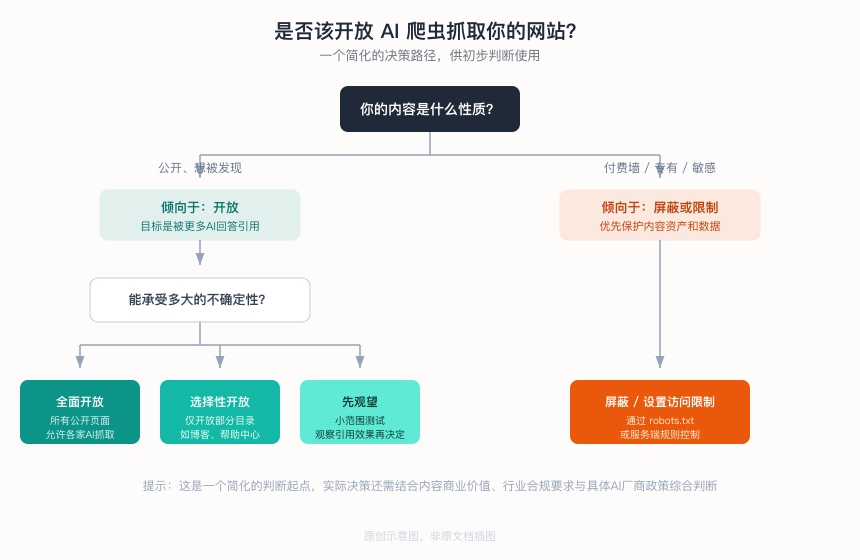
If your content is meant to reach as many people as possible—blog posts, product descriptions or help documentation—allowing access is usually a natural choice. If the content is a core asset that earns money directly, consider the implications before defaulting to open access. Technically, most websites can userobots.txtor server-side rules to set permissions for individual AI crawlers. Access can be selective; it is not an all-or-nothing choice.
5. What an ordinary team can actually do
After all the principles, let us return to the practical question: what should I do at work tomorrow?
Start by understanding where you stand. Before making changes, ask AI some genuine questions relevant to your business. Check whether your brand appears, how it is described and what the answers say about competitors. This step is often skipped, leaving every later optimization based on guesswork. Tools such as HubSpot's AI Search Grader can do this at scale, but asking several questions manually also gives you a useful initial picture.
Break long content into passages that can be quoted directly. A guide running to five thousand Chinese characters can be hard for AI to mine for a precise answer if it contains extensive background and digressions. Clear subheadings and FAQ-style sections work better: give each subquestion a self-contained answer that readers can understand on its own without reading everything before it.
Here is a practical example. Suppose your company makes collaboration software. Your old content strategy might have been to write a “Top Ten Team Collaboration Tools” article and place your own product near the top. A more useful approach now may be separate, clearly structured articles that explain how to handle specific situations, such as reducing excessive meetings in remote teams or coordinating progress across time zones. AI is more likely to use this content as an authoritative answer than dismiss it as another disguised sales pitch.
Look beyond your website: AI listens elsewhere too. Real Reddit discussions, specialist forums, app-store reviews and review websites are among the sources many AI products explicitly use. A brand with sustained, genuine positive discussion in these places is naturally more credible than one that only praises itself on its own blog. Taking negative reviews seriously and participating in real industry discussions may bring more practical value than writing another ten promotional articles.
Do not overlook established media and PR. Several AI companies have signed content-licensing agreements with established news outlets and publishers. Coverage in those channels can therefore indirectly increase a brand's chances of appearing in AI answers. Occasionally securing a substantial media feature may offer better value than spending the entire budget on your own content farm.
Update content regularly instead of forgetting it after publication. An article published three years ago with outdated figures may be nearly as unhelpful to AI as no article at all; conflicting information may even make it seem unreliable. Make content audits routine—even a quarterly check of key-page data can be more worthwhile than continuously producing new material.
6. Traditional search still matters: keep your channels diversified
Not everyone has replaced search with AI. Traditional search engines still carry substantial real traffic, especially for queries with strong purchase intent, price comparisons or local-service needs.
The good news is that AI-friendly content and effective traditional SEO share many fundamentals: accurate information, clear structure and credible sources work for either kind of reader. Often, the main adjustment is presentation: frame titles as real questions, lead with the answer and make paragraphs self-contained. These are modest changes that can help both channels, without requiring you to rebuild your entire content system for AI.
Final thoughts
The biggest change brought by AI search may be less technical than strategic: brands no longer fully control how users encounter them. That can feel unsettling. But the shift also gradually disadvantages empty, keyword-stuffed content. Brands that consistently write honestly, clearly and with enough substance to answer follow-up questions may be better equipped to navigate it.
Technology will keep changing, and the specific platform behaviors discussed here may look different in six months. But asking whether a piece of content genuinely solves someone else's problem has never become outdated.
The comparison table and decision diagram in this article are original summaries based on publicly available industry information, not reproductions of illustrations from any particular document.