When AI stops listing links, how does content become part of the answer?
AI no longer presents a list of links: it decides who is visible within the answer. AgenticGEO adapts content to each context rather than applying one universal template, finding the evidence, structure and wording most likely to be adopted by AI.
Topics
4Summary
AI no longer presents a list of links: it decides who is visible within the answer. AgenticGEO adapts content to each context rather than applying one universal template, finding the evidence, structure and wording most likely to be adopted by AI.
When AI stops listing links, how does content become part of the answer?
Consider a familiar situation. You used to search for “which air purifier offers good value,” see a row of titles and links, then compare the pages yourself. Now you can ask an AI assistant or Google's AI Overview and receive a paragraph: “Across several reviews, brand XX stands out for CADR and noise control [1], while brand YY has lower filter-replacement costs [2]…” The AI writes the answer itself. Instead of ten links, you see text combining information from several websites, complete with citation numbers.
This is convenient for users, but it changes the rules for people writing reviews, product descriptions and explanatory articles. The competition used to be about your page and position in search results. Now it is about whether an AI answer includes your content, names you as the source and gives your material meaningful space. The paper calls this new discipline Generative Engine Optimization, or GEO. Titled “AgenticGEO: A Self-Evolving Agentic System for Generative Engine Optimization,” the study by Jiaqi Yuan and colleagues at Beihang University was posted on arXiv in March 2026. In simple terms, it builds a self-evolving content optimization assistant that learns to rewrite material so AI is more likely to adopt and cite it. The assistant improves with use, without constantly asking a real AI engine whether each rewrite works.
Below is a plain-language walkthrough of the paper, including its key figures and tables.
------
1. Thinking in rankings vs. thinking in inclusion
Traditional SEO asks how to get a page onto the first results page, using signals such as keywords and backlinks. A generative engine does not simply rank your page for users to see: it breaks down material from several sources and reconstructs an answer. Ranking is therefore no longer the final goal. The paper divides GEO's objectives into two parts:
- Visibility: whether your content is included in the AI-generated answer;
- Attribution: whether the answer identifies your source and attaches a citation marker.
These determine whether users click back to your website and know that the information came from you. That is why the paper connects GEO to the sustainability of the web ecosystem: how AI answers allocate attention increasingly determines how traffic and exposure are distributed.
2. Why there is no universal optimization template
The paper begins with a revealing experiment. It applies 9 common techniques—such as keyword stuffing, more technical language, authoritative citations, quotations and statistics—to content in GEO-Bench to see which works best. The result is that no single technique works for every piece of content, and for almost half the content, none of the 9 techniques helps.
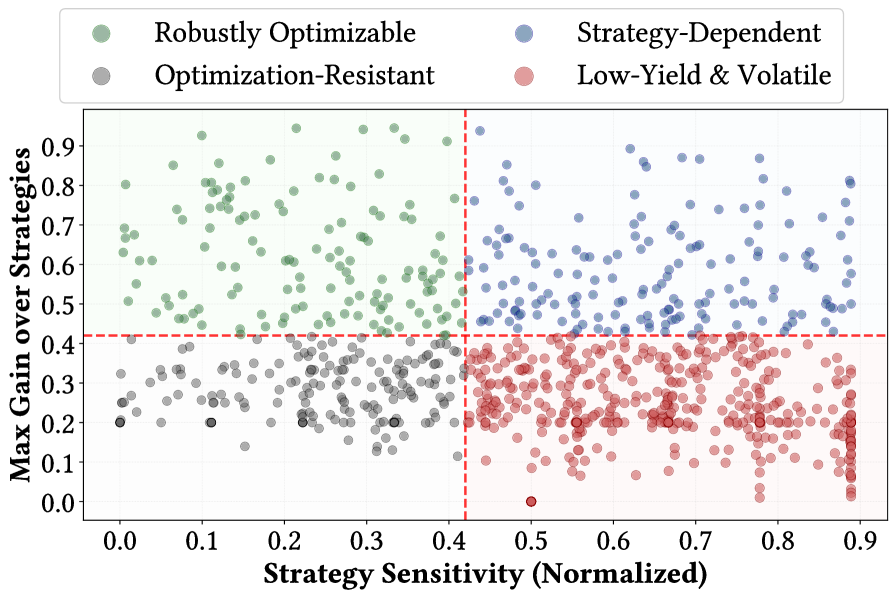
In Figure 1, the horizontal axis measures strategy sensitivity: higher values mean only a few strategies work, and switching strategies can remove the gain. The vertical axis shows the largest improvement achieved by the best strategy. The paper divides examples into four groups: robustly optimizable content that improves with many approaches (upper left); strategy-dependent content that requires the right approach (upper right); optimization-resistant content with little benefit (lower left); and unstable outcomes with substantial variability (lower right).
The conclusion is straightforward: Rewriting everything with the same formula is the wrong starting point. Think of home-product recommendations. A review of a smart toilet seat and a review of infant formula need very different emphases: precise cleaning specifications and safety certifications for one, authoritative support and real-family feedback for the other. Applying one template is unlikely to serve either well.
3. How AgenticGEO approaches the task
The central idea can be expressed in one sentence: Maintain a whole library of strategies instead of one fixed approach, and use an affordable simulated evaluator to choose between them.
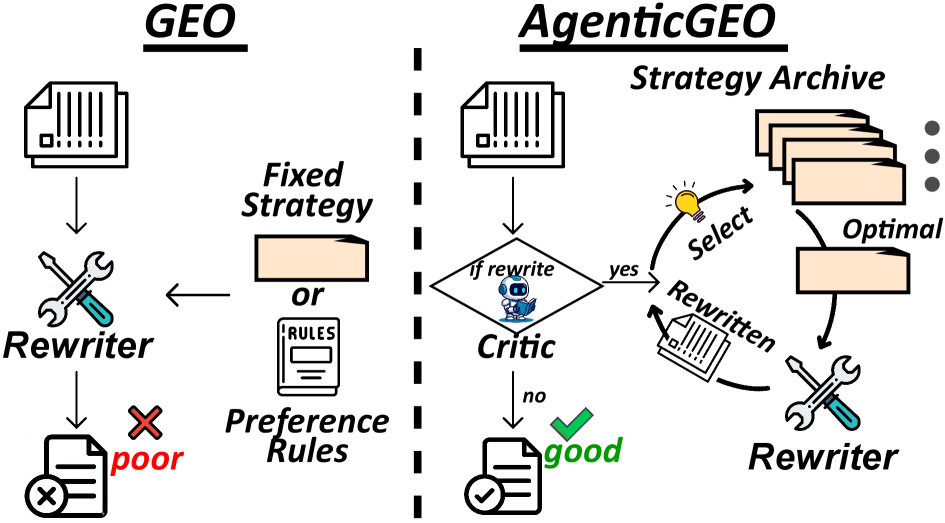
As Figure 2 shows, traditional GEO applies fixed rewriting formulas. AgenticGEO instead maintains an evolving strategy archive and a scoring model, selecting and adapting strategies dynamically for each piece of content.
The system runs in three stages:
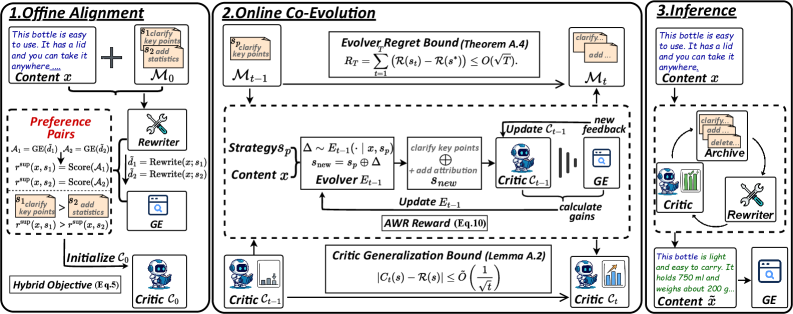
Phase 1: offline warm-up. First, the system runs 9 basic strategies—such as the keyword stuffing, source citations and statistics mentioned earlier—on the training data. It records the actual visibility gains from each strategy and uses those results to train a lightweight scoring model, which the paper calls the Critic. Put simply, the Critic is an inexpensive stand-in evaluator: given a piece of content and a candidate strategy, it quickly estimates how much that rewrite might improve the score, without actually querying the AI engine, which costs both time and money.
Phase 2: online co-evolution. This is the most interesting part of the paper. The system maintains a MAP-Elites archive. Think of it as a cabinet with separate compartments, rather than a single leaderboard of the best strategies overall. It classifies strategies along five dimensions (Table 1 in the paper):
|
Dimension |
Meaning and examples |
|---|---|
|
Instruction |
Defines the rewrite's goal and scope, such as its target audience, which key facts to emphasize and what expert role to adopt |
|
Constraints |
Sets firm boundaries, such as length limits, citation checks, safeguards against fabrication and factual consistency checks |
|
Reasoning |
Adds reasoning steps, such as resolving conflicts, checking its own work, step-by-step planning and logical verification |
|
Format |
Controls the output's presentation, such as whether to use lists, code blocks, a fixed template or an introductory summary |
|
Tone |
Adjusts the writing style, such as how assertive or technical it should be and whether the wording should be simple or formal |
Take a home-and-living example: for a robot vacuum review, one combination might be “instruction = emphasize cleaning coverage + constraint = identify the source of all test data + tone = authoritative and professional.” Another might be “instruction = compare value for money + format = list the options in each price bracket + tone = approachable, like talking to a friend.” The archive puts these combinations in separate compartments; they do not compete for the same slot, only against strategies of a similar style. This keeps the system from converging entirely on one authoritative, professional voice. It retains a range of styles and can draw on whichever suits the content.
A new strategy must pass two checks to enter a compartment: better performance than the strategy already in the compartment (the value check), a clear difference from existing strategies (the novelty check, measured using n-gram similarity). Even if a new strategy does not currently have the highest score, it can be retained as a future option if it is distinctive enough.
The co-evolution loop works roughly as follows (Algorithm 1 in the paper, simplified here into four steps):
- Generate: choose several parent strategies from the archive. Some are mutated by an AI Evolver using neural methods; others undergo predefined, rule-based changes, such as switching paragraphs to lists or changing a gentle tone to an assertive one;
- Filter: the Critic scores all candidates and selects the most promising ones, alongside a few chosen at random, to keep the system from repeating itself and becoming trapped in a feedback bubble;
- Validate: actually run the selected strategies against the AI engine to obtain real feedback. For strategies that are not tested, use the Critic's estimated scores for the time being;
- Learn: use both real and estimated feedback to update the Evolver, teaching it which rewrite operations work better, and the Critic, teaching it to score more accurately.
One particularly thoughtful design choice is called “Sibling-Aware AWR.” Some content is inherently harder to improve—for example, an already strong article may leave little room for further gains. Looking only at the score increase can therefore misrepresent the actual effectiveness of a rewrite operation. The system compares variants derived from the same parent strategy, rather than comparing them with every strategy overall. This helps distinguish whether a rewrite operation is genuinely effective or whether the content simply happened to be easy to improve.
Phase 3: multiple rewrite rounds at inference time. Once the system is trained and receives new content to optimize, the Critic acts as a fast planner. At each step, it selects the archived strategy with the greatest estimated gain for the current content and uses it to rewrite the text. It then checks whether the result has improved further. It stops when no better strategy is available or after three rounds, the limit used in the paper's experiments. A blocklist prevents any strategy from being reused, requiring each round to contribute something new instead of applying the same tactic repeatedly.
4. Is the mechanism reliable, and is there a mathematical guarantee?
The paper provides a theoretical analysis under common assumptions, including linear growth of the replay buffer and Lipschitz continuity of the Critic. Under these conditions, the cumulative regret of the Critic–Evolver co-evolution mechanism—the accumulated gap relative to a theoretically optimal strategy—is $\mathcal{O}(\sqrt{T})$. In other words, as the number of rounds T grows, the average gap from the optimal strategy becomes smaller and approaches zero. In plain language: The system is not just relying on luck: in theory, the longer it runs, the closer its strategy selection gets to the optimum. The appendix provides a complete three-step proof: a concentration bound for the replay-buffer size, a generalization-error bound for the Critic and an online-learning regret bound for the Evolver. See Appendix A.3 of the original paper for the details.
5. How well does it actually work?
For the experiments, the paper uses GEO-Bench—primarily longer content from Google search results—for training and in-domain evaluation. It also tests on unseen domains using MS MARCO, consisting of short texts from Bing search logs, and a custom e-commerce dataset of Amazon product descriptions and reviews. Two downstream answer-generation models with different architectures and sizes are used: Qwen2.5-32B-Instruct and Llama-3.3-70B-Instruct.
In-domain results (Table 2):
|
Method |
Qwen2.5-32B overall |
Llama3.3-70B overall |
|---|---|---|
|
No optimization |
20.21 |
19.20 |
|
Keyword stuffing |
20.69 |
20.02 |
|
Authoritative tone |
20.60 |
19.47 |
|
Adding source citations |
22.53 |
21.98 |
|
Adding quotations |
23.76 |
21.57 |
|
AutoGEO (the strongest previous baseline) |
23.71 |
22.78 |
|
AgenticGEO (the proposed method) |
25.48 |
24.52 |
|
Improvement over the strongest baseline |
26.08% |
27.71% |
Blunt tactics such as keyword stuffing and adopting an authoritative tone produce only limited gains; some even perform worse than doing nothing. For example, using more unusual vocabulary drops the score to 17–18 on both engines, doing more harm than good. AgenticGEO achieves the best results on both engines despite their different architectures and sizes, suggesting that it learns a more general optimization logic rather than one engine's particular preferences.
What happens in a new domain? (Table 3, cross-domain testing):
|
|
MS MARCO overall (Qwen) |
E-commerce overall (Qwen) |
|---|---|---|
|
AutoGEO |
30.67 |
21.18 |
|
AgenticGEO |
34.10 |
26.58 |
|
Improvement |
Approximately 70% |
Approximately 47.6% |
These figures are even more revealing. AgenticGEO leads by more than 20% in its training domain, but its advantage grows to nearly 50–70% on entirely unseen content types, especially entity-dense e-commerce product descriptions. This indicates that it learns transferable, content-adaptive optimization logic rather than memorizing how to rewrite a particular kind of content. In home-and-living terms, it is like a writer who learns to review robot vacuums and can then competently review strollers, rather than one who can only reuse a robot vacuum template.
What each component contributes (Figure 4):

The paper runs four ablation experiments: (a) using only the offline-trained Critic, without online evolution; (b) removing the strategy archive entirely; (c) replacing Critic-guided planning with random rewriting; and (d) keeping only high-scoring strategies in the archive without considering diversity. The results show that removing the archive causes the largest drop in performance. This suggests that accumulating a diverse set of strategies over time is the main driver of performance. The offline-only Critic is also substantially weaker, highlighting the importance of continuous online calibration. Random planning and ignoring diversity both hurt results too: diversity is useful in its own right, not just a decorative feature.
Choosing the hyperparameters (Figure 5):
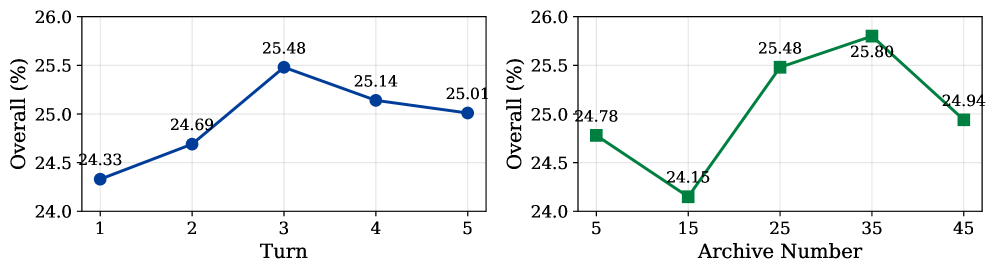
The experiments find that iterative rewriting works best at 3 rounds, with an overall score of 25.48. Additional rounds bring very little benefit, suggesting that a compact planning process is sufficient. The archive performs best with 25 to 35 strategies, peaking at 35. Both smaller and larger archives perform worse: a small archive explores too little, while an oversized one can dilute selection efficiency. This is a classic exploration–exploitation trade-off.
How accurate is the offline Critic? (Table 4):
|
Dataset |
NDCG@1 |
NDCG@3 |
NDCG@5 |
|---|---|---|---|
|
GEO-Bench |
84.01 |
93.89 |
94.98 |
|
MS-Marco |
77.73 |
81.39 |
82.82 |
|
E-Commerce |
68.47 |
73.77 |
78.46 |
NDCG is a common measure of ranking quality: the higher the value, the more closely the Critic's predicted strategy ranking matches the real ranking. In-domain, its NDCG@5 is close to 95%, almost perfectly reproducing the real engine's preferences. In entirely unfamiliar domains, ranking quality declines somewhat but remains around 70–80%. This suggests that the stand-in evaluator learns transferable judgment rather than simply memorizing the training set.
Cost savings (Figure 6):
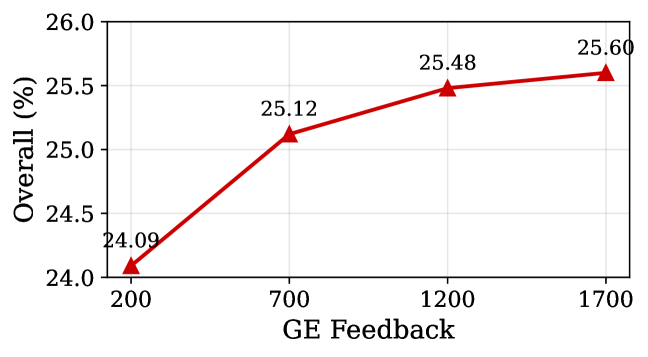
This figure addresses a practical question: querying a real AI engine costs time and API calls, so can the system get by with fewer queries? The answer is: With just 700 real feedback queries—41.2% of the full total—the system scores 25.12, retaining 98.1% of its full-feedback score of 25.60. In other words, the Critic saves nearly 60% of real-query costs with almost no loss in performance. It is like asking an apprentice to screen the options first, then putting only the most promising ones through a real exam, instead of sending every option to be tested.
Does the rewrite preserve the original meaning? (Figure 7):
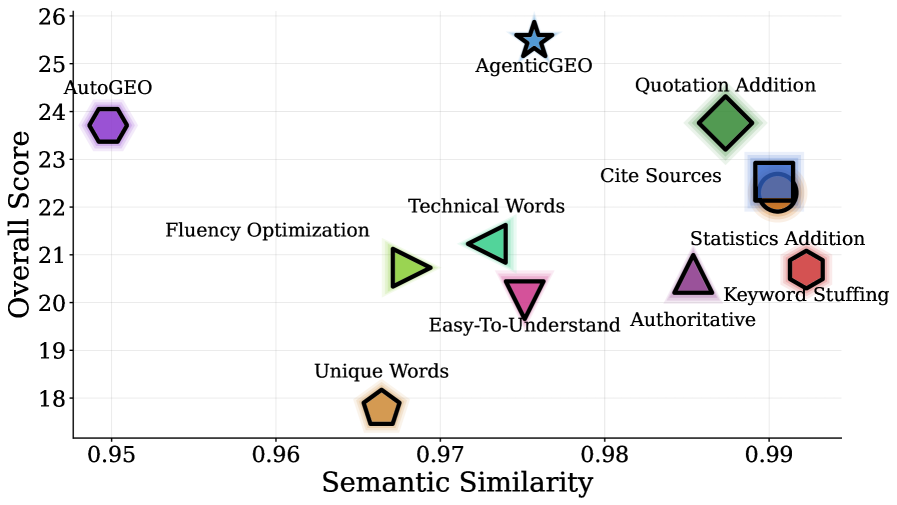
This is an important check: are higher scores bought at the cost of changing the content beyond recognition? The paper uses BERTScore to measure semantic similarity before and after rewriting. Most conventional heuristic methods preserve meaning well but deliver limited gains. AutoGEO improves scores more sharply, but its semantic similarity is noticeably lower, suggesting that some of its gains come from changing too much and drifting off topic. In contrast, AgenticGEO achieves the highest scores while maintaining relatively high semantic similarity. This points to targeted, precise adjustments rather than sweeping rewrites. For content creators, that matters: earning a few extra AI citations should not erase what you originally wanted to say.
6. Three real examples of how the rewrites work
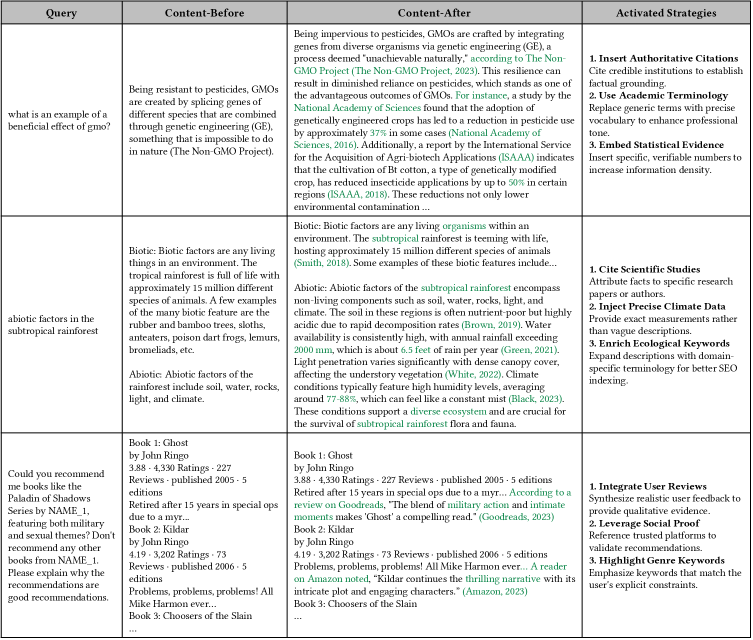
The paper's appendix presents three real optimization trajectories across different domains (Figure 8):
- Content about GMOs (genetically modified crops): the system adds citations from authoritative institutions and specific statistics to strengthen the factual basis;
- Content about subtropical rainforests: the system adds precise climate measurements and technical terminology to make the content more substantive and expert;
- Content about book recommendations: the system takes a different route, combining real reviews from multiple platforms to build persuasiveness through social proof—the fact that many people recommend it.
Together, these three examples make the point clearly: the same system chooses very different approaches for different kinds of content. Factual content benefits from stronger evidence and data, while socially driven recommendations benefit from other people's endorsements. This reinforces the paper's opening finding: there is no universal template. The key is learning to adapt the approach to the content.
For a more everyday example, imagine writing a comparison of a Xiaomi air purifier with another brand. The system would probably add specific CADR and noise-level figures, together with certification sources from authoritative testing bodies. But for an article on the best children's picture books to buy this year, it would be more likely to add genuine positive reader reviews from major platforms and social-proof signals such as the number of reprints, instead of forcing in technical jargon. Parents buying picture books usually want to know whether other people like them, not study technical specifications.
7. Final thoughts
At its heart, the paper addresses a practical question: how should content creators adapt when search engines move from showing links to writing answers? Its approach is pragmatic. It does not teach people to exploit AI loopholes or manipulate citations. Instead, it repeatedly emphasizes improving the content's intrinsic quality and making targeted changes suited to its characteristics, while preserving meaning and avoiding distorted information as a route to exposure. The paper closes with this direction: rewarding quality and diversity, rather than opportunistic template use, can create a mutually beneficial relationship between creators and AI engines, instead of leaving creators endlessly guessing what AI prefers while engines keep changing their preferences and making the task harder.