How creators can earn citations in AI answers
Keyword stuffing is losing its effectiveness in generative search. Sources, data, quotations and clear structure offer better opportunities for citation. The KDD 2024 GEO paper shows that even small websites can regain visibility in AI answers through content quality.
Topics
4Summary
Keyword stuffing is losing its effectiveness in generative search. Sources, data, quotations and clear structure offer better opportunities for citation. The KDD 2024 GEO paper shows that even small websites can regain visibility in AI answers through content quality.
How creators can earn citations in AI answers
Original paper: Pranjal Aggarwal, Vishvak Murahari, Tanmay Rajpurohit, Ashwin Kalyan, Karthik Narasimhan and Ameet Deshpande, “GEO: Generative Engine Optimization,” KDD 2024. arXiv:2311.09735
The problem this paper sets out to solve
Over the past thirty years, search engines have transformed access to information, yet their basic task has remained simple: accept keywords and return relevant links, leaving users to read and assess the results. Large language models changed that. Products such as BingChat, Google's SGE and Perplexity.ai retrieve several pages, synthesize their information and generate natural-language answers with citations. The paper groups these systems under the term generative engine (GE).
Generative engines benefit users, who get answers faster, and developers, who gain engagement and business value. But one group has been left out: websites and content creators. Traditional search at least sends users to the original site. Generative engines digest the content within the answer, so users may never need to open the original link, reducing a website's exposure and traffic. Compounding the problem, these engines are black boxes that evolve rapidly. Creators do not know how their material is retrieved, summarized or cited, and lack tools to improve its visibility.
The authors therefore introduce Generative Engine Optimization (GEO) —in a sense, the next generation of SEO—the first framework specifically designed to help content creators optimize their visibility in generative engines. They also build a benchmark of around ten thousand queries to evaluate optimization methods rigorously: GEO-bench. The experiments show that suitable optimization methods can improve a piece of content's visibility in generative-engine answers by up to 40%, with gains also reproduced on the live product Perplexity.ai, reaching up to 37%.
How generative engines actually work
The paper first provides a formal definition. A generative engine accepts a user query $q_u$ and optional personalization information $P_U$, then produces a natural-language response $r$:
$$f_{GE} := (q_u, P_U) \rightarrow r$$
It has two internal components:
- A set of generative models $G=\{G_1, G_2, ..., G_n\}$, each responsible for a subtask such as rewriting queries, generating summaries or writing the final answer;
- A search engine $SE$, which returns a set of candidate sources $S=\{s_1, s_2, ..., s_m\}$ for a query.
The typical workflow described in the paper, shown in Figure 2 and similar to BingChat's design at the time, has three steps:
- Query rewriting: a rewriting model $G_{qr}$ breaks the user's original question into several subqueries better suited to retrieval;
- Retrieval and summarization: the subqueries go to a search engine, which returns ranked source pages; a summarization model $G_{sum}$ then summarizes each source;
- Answer generation: the response model $G_{resp}$ combines the summaries into a coherent answer with sentence-level source citations.
Because large language models can hallucinate, citations are essential. Ideally, every sentence should have a supporting citation (high citation recall), and every citation should genuinely support the sentence it accompanies (high citation precision). The paper focuses on single-turn, question-and-answer engines, while its appendix also discusses extending the approach to multi-turn conversations.
A new definition of visibility
SEO's core logic is simple: the better a page's average ranking in search results, the more exposure and traffic it receives. This does not translate directly to generative engines, which do not simply present a ranked list of links. Instead, they take information from several sources and blend it into a single passage, where citations can appear anywhere, vary in length and take many different forms.
The paper therefore introduces impression metrics designed specifically for generative engines, guided by three principles: practical relevance to creators, interpretability and accessibility to ordinary content creators. These include:
1. Word Count: the total number of words in sentences citing a source, divided by the total words in the answer. If a sentence cites multiple sources, its word count is shared equally among them. The intuition is simple: the more space a source's cited content occupies, the more visible that source is in the answer.
2. Position-Adjusted Word Count: builds on Word Count by giving greater weight to cited sentences that appear earlier in the answer, with the weight decreasing exponentially by position. Click-through research shows that attention to search results declines with rank according to a power law. The paper applies a similar idea to the order of sentences in generative-engine answers.
3. Subjective Impression: the first two metrics count objectively, but visibility also has dimensions that word counts cannot capture: relevance to the question, contribution to the overall answer, uniqueness, perceived prominence, likelihood of a click and diversity of the information presented. The paper uses G-Eval, a GPT-based automated evaluation method regarded as effective, to score seven subdimensions. It then normalizes the scores to a mean and variance comparable to Position-Adjusted Word Count.
These metrics are more complex than checking a ranking, but better reflect how generative-engine answers are structured. Figure 3 contrasts a traditional results page—a linear ranked list—with an answer whose citations are woven into a passage at different positions and lengths. That difference is precisely why new visibility metrics are needed.
Nine practical GEO optimization strategies
Once measurement is defined, the next question is how to improve results. The paper uses large language models to rewrite website text and tests 9 strategies. Each is essentially a function $f: W \rightarrow W’$, turning the original webpage content $W$ into optimized content $W’$:
|
Strategy |
Approach |
|---|---|
|
Authoritative |
Make the writing more persuasive and authoritative |
|
Statistics Addition |
Replace qualitative descriptions with quantitative data wherever possible |
|
Keyword Stuffing |
Add more query-related keywords, as in traditional SEO tactics |
|
Cite Sources |
Add citations from credible sources |
|
Quotation Addition |
Add direct quotations from authoritative individuals or institutions |
|
Easy-to-Understand |
Simplify the language to make the text easier to understand |
|
Fluency Optimization |
Improve the text's flow and readability |
|
Unique Words |
Add uncommon, distinctive wording |
|
Technical Terms |
Add specialist or technical vocabulary |
Keyword Stuffing, Cite Sources and Quotation Addition require some new material. The other six strategies improve presentation without adding information. For a fair comparison, one candidate source is chosen at random for each query and rewritten separately with all nine strategies, then the change in visibility is measured.
Evaluation with GEO-bench
With no public query dataset designed for generative engines available at the time, the authors created their own: GEO-bench, containing 10,000 queries from 9 sources, split into training, validation and test sets of 8000/1000/1000:
- MS MARCO, ORCAS-I and Natural Questions: real Bing and Google user queries from three established datasets widely used in search research;
- AllSouls (essay questions from All Souls College, University of Oxford), LIMA (challenging questions requiring reasoning and creative ability), Davinci-Debate (debate questions), Perplexity.ai Discover (trending queries on the platform), ELI5 (complex questions requiring explanations simple enough for a five-year-old), and GPT-4-generated queries (covering science, history and other fields, with navigational, transactional and other query intents).
The distribution aims to reflect real use: 80% of queries are informational, with transactional and navigational queries each accounting for 10%. Each query includes cleaned text from Google's top 5 source pages. GPT-4 also assigns labels across 7 dimensions—difficulty, query type, domain, specific topic, sensitivity, user intent and answer type—with annotation precision and recall checked manually. GEO-bench ultimately spans 25 domains, including art, health and gaming, 9 data sources and 7 classification dimensions, making it a sizable and diverse benchmark dedicated to generative engines.
The experimental generative-engine prototype follows the two-step design of earlier research (Liu et al., 2023): first, retrieve Google's top 5 sources; second, use gpt-3.5-turbo to generate an answer using a fixed prompt template. The full prompt appears in the appendix; its central requirement is to answer only from the supplied search results and place an inline citation immediately after every sentence. To reduce randomness, each query is sampled 5 times at temperature 0.7 and the results are averaged.
Main results: which strategies work?
The table below reproduces the paper's main comparison (Table 1), showing absolute scores for 9 strategies on two groups of metrics against a no-optimization baseline. Scores are normalized so the visibility of all citations sums to 1, then multiplied by a constant for readability. Higher values mean greater visibility:
|
Method |
Position-Adjusted Word Count (overall) |
Subjective Impression (mean) |
|---|---|---|
|
No optimization (baseline) |
19.3 |
19.3 |
|
Keyword stuffing |
17.7 |
20.2 |
|
Unique Words |
20.5 |
20.4 |
|
Easy-to-Understand |
22.0 |
20.5 |
|
Authoritative |
21.3 |
22.9 |
|
Technical Terms |
22.7 |
21.4 |
|
Fluency Optimization |
24.7 |
21.9 |
|
Source citations |
24.6 |
21.9 |
|
Quotation Addition |
27.2 |
24.7 |
|
Statistics Addition |
25.2 |
23.7 |
Several conclusions stand out:
- Traditional SEO tactics largely fail here. Keyword stuffing does not improve results and even scores below the baseline on Position-Adjusted Word Count. This suggests that the underlying models rely on meaning rather than keyword matching, and may recognize repetitive keyword use as low-quality content.
- The three strongest strategies are Quotation Addition, Statistics Addition and Cite Sources, improving over the baseline by 30%–40% on Position-Adjusted Word Count and 15%–30% on Subjective Impression. All three strengthen credibility and information density rather than simply dressing up the writing. Adding an authoritative source, a direct quotation or a concrete figure costs little but can deliver substantial gains.
- Somewhat surprisingly, Fluency Optimization and Easy-to-Understand, which only improve the writing style, also deliver gains of 15%–30%, suggesting that generative engines care not only about what is said but also how well it is expressed.
- By contrast, making the tone more authoritative and persuasive produces no substantial improvement. The paper interprets this as evidence that generative engines are somewhat robust to persuasion through tone alone. Creators should therefore invest in the credibility of their content rather than rhetorical packaging.
Further analysis
Different domains need different strategies
SEO has never had a one-size-fits-all tactic, and neither does GEO. The paper breaks down results by GEO-bench labels (Table 3) and finds:
|
Strategy |
Most suitable domains, ranked by effectiveness |
|---|---|
|
Authoritative |
Debate questions > history > science |
|
Fluency Optimization |
Business > science > health |
|
Source citations |
Declarative questions > factual questions > law and government |
|
Quotation Addition |
People and society > explanatory questions > history |
|
Statistics Addition |
Law and government > debate > opinion questions |
These patterns are intuitive. Debate questions benefit from persuasive argument; factual questions need citations that make claims verifiable. In domains such as law and government, where data and formal provisions matter, statistics can be more persuasive than abstract descriptions. Direct quotations add authenticity and depth to personal narratives and historical accounts. This reinforces the paper's repeated point: creators should choose strategies for their site's subject area rather than blindly apply a universal template.
Who benefits most when everyone uses GEO?
A natural question follows: if every creator adopts GEO, will the gains simply cancel out? The authors test this by optimizing all candidate sources for the same query simultaneously and measuring the relative gains for websites at each original ranking position (Table 2):
|
Method |
Rank 1 |
Rank 2 |
Rank 3 |
Rank 4 |
Rank 5 |
|---|---|---|---|---|---|
|
Authoritative |
-6.0% |
+4.1% |
-0.6% |
+12.6% |
+6.1% |
|
Fluency Optimization |
-2.0% |
+5.2% |
+3.6% |
-4.4% |
+2.2% |
|
Source citations |
-30.3% |
+2.5% |
+20.4% |
+15.5% |
+115.1% |
|
Quotation Addition |
-22.9% |
-7.0% |
+3.5% |
+25.1% |
+99.7% |
|
Statistics Addition |
-20.6% |
-3.9% |
+8.1% |
+10.0% |
+97.9% |
The result is clear: lower-ranked websites gain more from GEO. The top-ranked website may even lose visibility. With Cite Sources, for example, the site originally ranked fifth gains 115% in visibility, while the first-ranked site loses an average of 30.3%. Traditional rankings rely heavily on backlinks and domain authority, where accumulated advantages favor large organizations over smaller creators. Generative engines instead interpret and organize the content itself, allowing quality—citations, data and quotations—to translate directly into visibility without the same structural barriers. In other words, GEO could help narrow the digital divide between large websites and small creators —a promising sign for independent businesses and individual content creators.
Combining strategies works better
In practice, creators rarely use just one tactic. The paper tests pairs of the four strongest strategies—Cite Sources, Fluency Optimization, Statistics Addition and Quotation Addition—as shown in Figure 4's heatmap. The results indicate that Fluency Optimization plus Statistics Addition is the strongest pair, performing more than 5.5% better than either strategy alone. Interestingly, Cite Sources is the weakest of the four when used alone, about 8% below Quotation Addition, but paired with others it delivers an average gain of 31.4%, showing the strongest combination benefit. The lesson is that some strategies reveal their full value only in combination, so their standalone performance should not be the sole basis for rejecting them.
The table below recreates the gains from each pair using Figure 4's heatmap data. Each cell shows the average improvement over the baseline when the row and column strategies are combined:
|
|
Fluency |
Statistics |
Source citations |
Quotation Addition |
Row mean |
|---|---|---|---|---|---|
|
Fluency |
22.4% |
35.8% |
34.4% |
33.0% |
31.4% |
|
Statistics |
35.8% |
27.0% |
30.3% |
35.4% |
32.1% |
|
Source citations |
34.4% |
30.3% |
19.1% |
20.1% |
26.0% |
|
Quotation Addition |
33.0% |
35.4% |
20.1% |
30.3% |
29.7% |
Diagonal values, such as 22.4% for Fluency plus Fluency, represent applying the same strategy twice as a control. Off-diagonal cells show combinations of two different strategies. The Row mean column corresponds to the rightmost column in the original heatmap: it shows that although Cite Sources ranks last on its own, its average gain rises to third-highest when paired with other strategies.
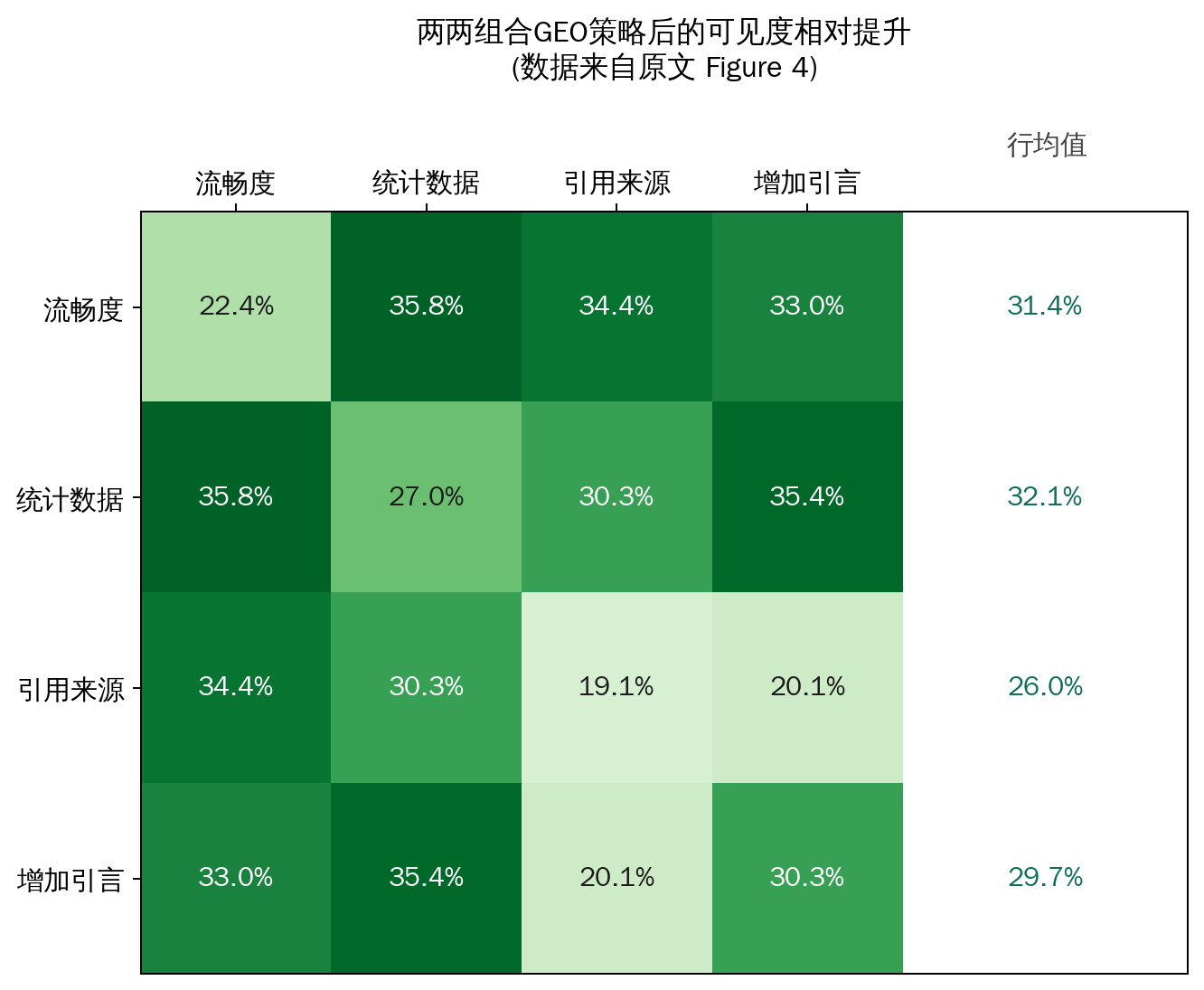
The chart above is redrawn from the data in Figure 4 of the original paper. Darker colors indicate greater gains from the combination.
What the real examples look like
The paper gives three clear examples in Table 4, illustrating Cite Sources, Statistics Addition and Authoritative. They share one feature: very small edits produce substantial visibility gains. Adding a research organization's source attribution to a statement about per-capita chocolate consumption in Switzerland increases visibility by 132.4%. Adding a specific growth percentage to a claim about robots replacing human labor produces a 65.5% gain. Rewriting a neutral statement about a sports team's record to sound more decisive and emphasize its achievements produces an 89.1% gain. These examples suggest that GEO often does not require creating new content. Adding a source or a figure, or adjusting how confidently a point is expressed, can be enough to improve existing material. The barrier to entry is low for ordinary creators.
Beyond the lab: testing on Perplexity.ai
To show the findings were not limited to an experimental setting, the authors applied the same methods to the live generative-engine product Perplexity.ai, testing a sample of 200 queries (Table 5). Because Perplexity.ai does not allow source URLs to be specified directly, source texts were uploaded as files and responses were restricted to those files.
|
Method |
Position-Adjusted Word Count |
Subjective Impression |
|---|---|---|
|
No optimization (baseline) |
24.1 |
24.7 |
|
Keyword stuffing |
21.9 |
28.1 |
|
Quotation Addition |
29.1 |
32.1 |
|
Statistics Addition |
26.2 |
33.9 |
The results closely match the laboratory findings: keyword stuffing still reduces Position-Adjusted Word Count, scoring about 10% below the baseline, while Quotation Addition and Statistics Addition remain strong, with gains of about 22% and 37%, respectively. These credibility-building strategies support three conclusions: generative engines need purpose-built optimization methods; the methods can generalize beyond a single experimental engine; and creators can apply these simple strategies to gain practical benefits on live products.
The study in a broader context
The paper distinguishes its contribution from three areas of earlier work:
- Evidence-supported answer generation: systems such as WebGPT train models to navigate the web and generate sourced answers, while other approaches generate answers from search results. GEO adds a unified evaluation benchmark on top of such systems. Unlike a recent study on manipulating LLM recommendations with adversarial text to increase product exposure, GEO proposes non-adversarial optimization strategies for content on any website.
- Retrieval-augmented generation: RAG, REALM and related work address language models' difficulty retaining knowledge. Generative engines have a broader task: they must produce answers with citations throughout and handle query rewriting, source selection and other subtasks, not retrieval alone.
- Traditional SEO: nearly 25 years of SEO research has focused on on-page optimization, improving content and experience, and off-page optimization, building backlinks and domain authority. That logic assumes search engines match keywords. It largely does not apply to generative engines driven by generative models and not limited to keyword matching—which is why GEO is needed.
Conclusion and limitations
The paper makes three contributions: a formal definition of generative engines, GEO, the first creator-focused optimization framework for generative engines, including visibility metrics and 9 specific strategies; and the development and open release of the GEO-bench evaluation benchmark. The central finding is that credibility-building changes—citations, quotations and statistics—can increase a site's visibility in generative-engine answers by up to 40%. Different domains suit different strategies, combinations usually outperform individual tactics, and lower-ranked small sites benefit especially strongly. This is encouraging for independent creators and small to medium-sized websites.
The authors also acknowledge limitations. First, generative engines evolve quickly, so GEO methods will likely need continuous updates, just as SEO has. Second, GEO-bench aims to reflect real query patterns, but those patterns change and the benchmark must be maintained. Third, the study does not assess whether GEO edits affect traditional search rankings, whose algorithms are themselves black boxes. The authors expect limited effects because GEO mainly changes text rather than domains, backlinks or other conventional ranking factors. Finally, longer model context windows may let future engines process more sources, further reducing the importance of original search rank. Overall, the paper lays foundations for a new field, offering a shared framework, metrics and benchmark on which later researchers can build.